
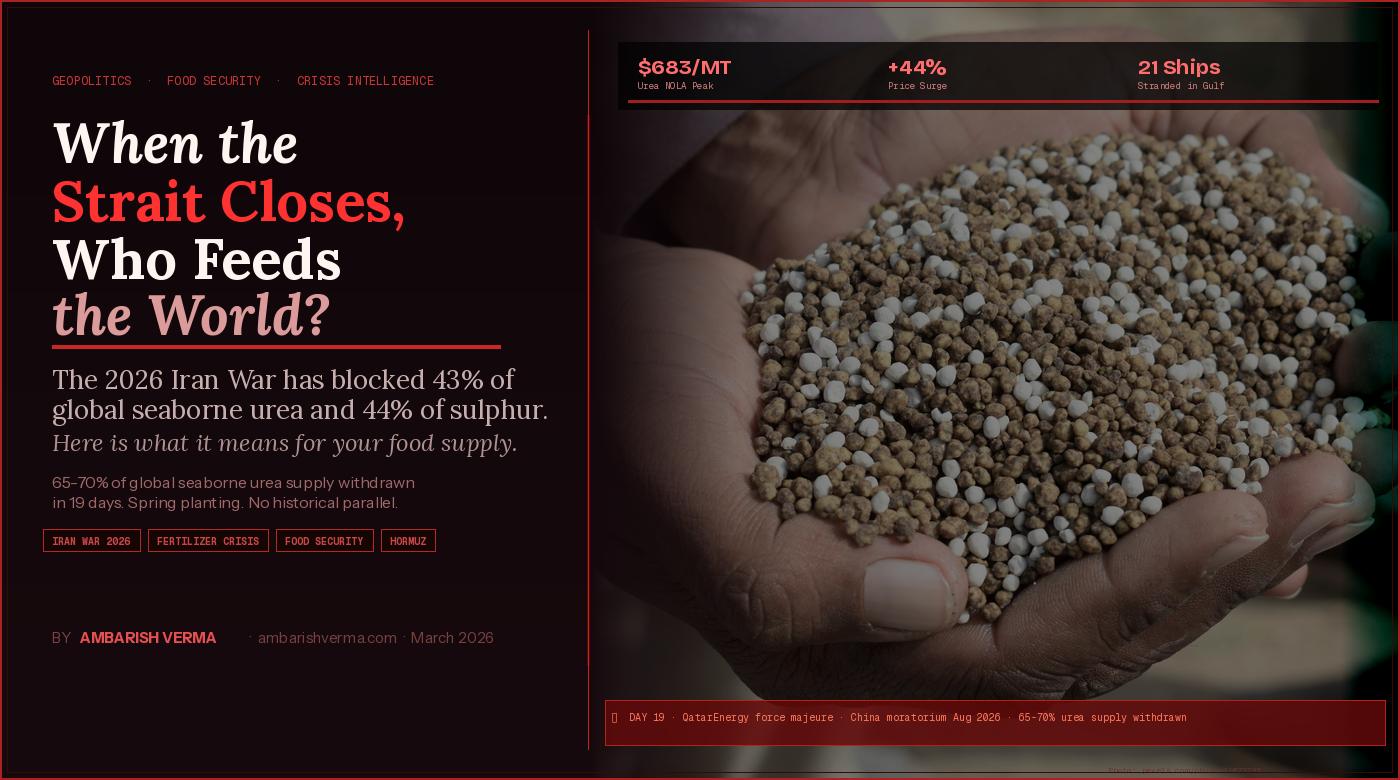

| ⚠ ACTIVE IRAN CONFLICT – Day 19 – The Strait of Hormuz handles 43% of global seaborne urea and 44% of global seaborne sulphur. Both are effectively blocked as of March 18, 2026. This article draws on Navadhi’s 77-page intelligence report published today – the most comprehensive available analysis of the crisis’s impact on global fertilizers. |
I want to start with something personal.
When I began building Navadhi’s Global Fertilizer Market Strategic Research Report in January 2026, I was focused on a straightforward analytical question: where is this USD 226 billion market heading over the next six years? I was writing about the structural crossing of Specialty & Biofertilizers over Potash by 2030, about the geopolitical bifurcation of supply chains, about the green ammonia transition, about nano-fertilizer globalisation.
I was not writing about a war.
By the time we published that report – March 18, 2026 – the world had fundamentally changed. US-Israel strikes on Iran began February 28. By Day 19, the Strait of Hormuz was effectively closed. QatarEnergy had declared force majeure. At least 21 ships carrying approximately one million metric tonnes of fertilizer were physically stranded in the Persian Gulf. And China had announced it would not export urea until August 2026.
We published a second report on the same day: a 77-page real-time intelligence assessment of what the Iran War is doing to the global fertilizer industry.
This post is my personal account of what that research revealed – and why I believe the implications are not just about fertilizer prices, but about food security for hundreds of millions of people who are not in the news cycle.
| $683+/MT Urea NOLA Peak Up from $516 on Feb 27 | 65–70% Seaborne Supply Cut Urea withdrawn in 19 days | 21 Ships Stranded ~1 million MT stuck in Gulf | +44% Peak Surge Largest w/w rise this decade |
Why Fertilizer Is Not Just a Commodity Story
Most people do not think about fertilizer until something goes wrong. In normal times, it is background infrastructure — the invisible input that allows the world’s farmers to produce enough food to feed eight billion people. In abnormal times, it is the first upstream indicator of a food crisis, arriving months before the shortages become visible at the grocery store or the humanitarian agency.
The 2022 Russia-Ukraine war gave us a warning. Russia and Belarus together supplied a significant share of the world’s potash. Russia also supplied a meaningful share of ammonia and urea. When those supply chains were disrupted, fertilizer prices doubled and then tripled. Farmers in India, Brazil, Sub-Saharan Africa, and Southeast Asia reduced application rates. The yield losses from under-fertilisation in 2022 contributed to the global food price inflation that disproportionately affected the world’s poorest populations throughout 2022–2023.
The 2026 crisis is structurally more dangerous on every dimension that matters.
The Hunger Chokepoint — What the Strait of Hormuz Actually Controls
I use the phrase ‘hunger chokepoint’ because it is analytically accurate, not because it is dramatic.
The Strait of Hormuz is a 33-kilometre-wide waterway separating Iran from the Arabian Peninsula. Through it, in normal conditions, transit:
▸ 43% of global seaborne urea Urea is the world’s most widely used nitrogen fertilizer. The Persian Gulf’s concentration of low-cost gas-to-fertilizer production — built over four decades at Saudi Arabia’s Ma’aden, Qatar’s QAFCO, UAE’s FERTIL, and Iran’s own massive production complexes — makes the Gulf the single most important source of traded nitrogen on earth.
▸ 44% of global seaborne sulphur This is the number almost nobody is reporting. Sulphur is not a fertilizer itself — it is the essential processing input for converting phosphate rock into DAP and MAP, the phosphate fertilizers that supply phosphorus to crops. Without sulphur, the world’s largest phosphate producer — Morocco’s OCP Group — cannot convert its own rock into fertilizer regardless of how much demand exists.
▸ 23–30% of global merchant ammonia Ammonia is the feedstock for ammonium nitrate, UAN, and numerous other nitrogen compounds, as well as a direct soil application in some markets.
| Here is what makes 2026 categorically different from 2022: the Strait closure does not just affect the price of fertilizer. It affects the physical availability of nitrogen AND the physical availability of the processing input for phosphate — simultaneously, during the three-week window when spring planting decisions are being finalised across the Northern Hemisphere. |
Three Supply Shocks in 19 Days — A Historical First
What distinguishes the 2026 crisis from every prior fertilizer supply disruption is not one shock — it is three, arriving in the same three-week window.
Shock 1 — The Hormuz Blockade
The US-Israel campaign against Iran began February 28 with the elimination of Supreme Leader Khamenei. By Day 2, QatarEnergy had halted all LNG production at Ras Laffan Industrial City, cutting feedstock to QAFCO — the world’s largest single-site urea facility — and to downstream nitrogen plants in India, Bangladesh, Pakistan, and Egypt. Iran’s own production, approximately 350,000–400,000 metric tonnes of urea per month (10–12% of global seaborne trade), was functionally eliminated. Arab Gulf monthly urea exports of approximately 1.5 million tonnes stopped. Insurance premiums for Gulf transit spiked over 1,000%. Lloyd’s of London suspended coverage. At least 21 ships carrying approximately one million metric tonnes of fertilizer are physically stranded in the Persian Gulf as of today.
Shock 2 — China’s Urea Export Moratorium
While global attention was focused on the Gulf, China quietly announced it will not export urea until August 2026. China typically accounts for 10–15% of global urea exports. The stated reason: domestic food security. This is nitrogen nationalism — a policy that prioritises domestic farmers over export revenues. Combined with the Gulf blockage, the cumulative supply withdrawal now represents approximately 65–70% of normally available global seaborne urea supply. No prior historical event — not the 2022 Russia-Ukraine crisis, not the 2008 food crisis, not any prior Middle East conflict — involved a simultaneous supply withdrawal of this scale.
Shock 3 — Egypt Compromised
Egypt was supposed to be the geographic alternative. Its Mediterranean and Red Sea export routes bypass Hormuz entirely, and Egypt is the world’s 5th or 6th largest urea exporter. But Egypt simultaneously lost its natural gas pipeline supply from Israel following Israel’s declaration of a state of emergency. Egyptian producers must now source LNG at spot prices, raising production costs an estimated USD 80–120 per metric tonne. Egypt can partially substitute for Gulf supply, but at higher cost and insufficient scale. The one available liferaft has a hole in it.
The Overlooked Crisis: The Sulphur Dimension
Every analyst is covering the urea price spike. Very few are covering what I believe is the more structurally significant dimension of this crisis: sulphur.
Sulphur is produced as a by-product of oil and gas processing. Approximately 44% of the world’s annual elemental sulphur supply comes from the Middle East — the same region now blockaded. Sulphur has one critical agricultural application: it is the chemical input required to convert phosphate rock into DAP (diammonium phosphate) and MAP (monoammonium phosphate), the phosphate fertilizers that supply phosphorus to crops worldwide.
The three largest sulphur buyers globally are China (sourcing 50%+ from the Middle East), Morocco’s OCP Group (sourcing 50%+ from the Gulf for its DAP and MAP production), and Indonesia (sourcing 70% from the Gulf for its rice and palm oil farming systems).
| This creates a paradox that is not widely appreciated: OCP Group — the world’s largest phosphate producer, controlling approximately 70% of the world’s phosphate rock reserves — faces a production bottleneck from the same conflict that is driving massive demand for its products. Morocco cannot convert its own phosphate rock into DAP without sulphur. The market is simultaneously creating exceptional demand and constraining supply for the same company. |
Argus Media analyst Marina Simonova described the situation as having ‘limited options to cover the shortfall.’ The critical distinction from oil: there are no strategic sulphur reserves anywhere in the world. There is no Saudi Arabia of sulphur that can open a tap.
The Human Stakes: Four Breadbaskets Under Pressure
The countries and regions most exposed to this crisis are not the wealthiest. They are the ones with the least capacity to absorb the shock.
| Indicator | As of March 18, 2026 (Day 19) |
| India — CRITICAL | 66% of imported urea + 50% of LNG feedstock from Gulf. 3+ plants cutting output. INR 1.9 lakh crore subsidy pressure. Kharif season (60% of food grains) at direct risk. 650 million farm-dependent people. |
| Brazil — SEVERE | 90%+ of fertilizer needs imported. 40%+ historically from Gulf. Amsul imports from China up 28% as partial substitute. Next soy planting window requires procurement decisions now. |
| US — HIGH | Urea NOLA +44% peak. Corn:urea ratio at 130+ bu/tonne (vs 75 in Dec 2025). 1–1.5M corn acres shifting to soybeans. DOJ antitrust probe simultaneously constraining producer pricing freedom. |
| Sub-Saharan Africa — CATASTROPHIC | 17 kg/ha (vs 135 global average). No strategic reserves. USAID safety net eliminated. OCP feedstock constrained. No policy mechanisms remain intact for emergency response. |
| Southeast Asia — SEVERE | Indonesia: 70% sulphur dependency from Gulf. Rice and palm oil seasons at direct risk. Vietnam, Thailand, Philippines rely on Gulf urea for rice programmes. |
Iran as a Fertilizer Market Actor — A Perspective Few Reports Address
Something that struck me in building this research: Iran itself was a significant fertilizer market participant — not just a geopolitical actor. Until February 28, Iran was the world’s 5th or 6th largest urea exporter, producing approximately 350,000–400,000 metric tonnes per month from its massive Mahshahr and Assaluyeh production complexes, powered by South Pars natural gas at the world’s lowest domestic industrial gas prices.
Iran’s structural competitive position in the fertilizer industry was genuinely extraordinary: domestic gas at approximately USD 0.10–0.15 per MMBtu (versus USD 2–4 in North America and USD 8–14 in Europe) gave it a production cost advantage of USD 80–150 per tonne over virtually every competitor globally. That advantage is, for the moment, entirely irrelevant — because the infrastructure that converted that cheap gas into exportable urea has been damaged, the management authority to coordinate post-conflict reconstruction was eliminated with the killing of Supreme Leader Khamenei on Day 1 and SNSC head Larijani on Day 17, and the sanctions regime that will follow the conflict will exclude Iranian urea from Western-aligned supply chains for the 2026–2031 forecast period.
The strategic implication is uncomfortable: one of the world’s lowest-cost fertilizer producers has been effectively removed from the global market for the better part of a decade. The food security cost of that removal falls disproportionately on the world’s poorest countries, who benefited most from Iranian urea’s price competitiveness.
Five Things That Will Be Different When the Strait Reopens
The most important insight I can share from this research is about what happens after the conflict ends — not during it. These five structural changes will persist regardless of when Hormuz reopens.
▸ 1. Strategic fertilizer reserves will become national policy The 1973 oil crisis created the Strategic Petroleum Reserve. The 2026 fertilizer crisis will create its equivalent. Every government in the Minerals Security Partnership will implement fertilizer reserve programmes — particularly for nitrogen and phosphate. This is not speculative; it is already being discussed in Washington, Brussels, and Delhi. CF Industries, Nutrien, and Canada’s Bethune potash are the designated supply sources for these programmes.
▸ 2. ‘Nitrogen nationalism’ has arrived and will not leave China’s August 2026 urea export moratorium is the first explicit act of nitrogen nationalism — domestic food security over export revenues. This policy logic will spread to any country with surplus nitrogen production capacity when the next supply shock arrives. The globally integrated nitrogen market that operated from the 1990s through 2022 is not coming back.
▸ 3. Green ammonia’s commercial timeline just compressed by two years Every week of Gulf supply disruption strengthens the investment case for hydrogen-based nitrogen production that has zero Gulf energy dependency. Yara’s Porsgrunn pilot, CF Industries’ Donaldsonville CCS project, and OCP’s green hydrogen programme all receive accelerated political and financial support. The Iran War made what was a 2030 commercial story into a 2027 commercial story.
▸ 4. H2 2026 food price inflation is effectively locked in The yield impact of under-applying nitrogen during spring 2026 planting will be visible in the autumn 2026 harvest. This is not reversible. Wheat futures have already priced it in — surging 10% on a single day (March 11). Central banks that are not modelling the upstream fertilizer channel in their H2 2026 inflation forecasts are missing an important variable.
▸ 5. The ‘Nitrogen Fortress’ will never be fully trusted again The Persian Gulf’s concentration of low-cost nitrogen production — built over 40 years at enormous investment — was always a concentration risk. That risk has now been realised in the most dramatic way possible. Procurement directors, sovereign food security planners, and agricultural input buyers across the Western-aligned world will permanently increase their North American and European supply contracts as a security floor. The security premium for non-Gulf, MSP-aligned supply chains is now structurally embedded in global fertilizer pricing.
How the Iran War Changes the 2026–2031 Fertilizer Forecast
I want to be specific about the relationship between our two published reports.
The Global Fertilizer Market Strategic Research Report 2026–2031 — published on the same day — forecasts a market growing from USD 226 billion in 2025 to USD 283 billion by 2031 at a 3.90% CAGR. The four segment CAGRs — Nitrogen 2.54%, Phosphate 4.74%, Potash 3.94%, Specialty & Bio 5.67% — were built on the assumption that the Iran War was a geopolitical risk to be modelled as a scenario, not a realised event.
The Iran War does not invalidate the base forecast. It accelerates it and compounds it in specific ways:
▸ Phosphate CAGR upward pressure The supply tightening that was driving the 4.74% CAGR has dramatically accelerated. Saudi Ma’aden stranded. Gulf sulphur disrupting OCP. Chinese restrictions continuing. DAP at USD 530–560/MT versus USD 450–470 pre-conflict. The Phosphate segment’s absolute revenue gain through 2031 will be higher than the base forecast assumed.
▸ Specialty & Bio crossing Potash — now earlier Our base forecast found Specialty & Biofertilizers overtaking Potash in total revenue by 2030. The conflict accelerates this crossing because every structural driver of Specialty adoption — precision agriculture, carbon markets, green ammonia, biological inputs — has been dramatically reinforced by the energy security crisis.
▸ Nitrogen volume growth further moderated The conflict has simultaneously increased nitrogen prices (bullish for revenue) and accelerated adoption of nitrogen efficiency technologies including nano-urea, precision agriculture, and enhanced-efficiency fertilizers (bearish for volume). The base CAGR of 2.54% for Nitrogen is now a ceiling, not a central estimate.
▸ Geopolitical bifurcation compressed by 3–5 years The Western vs. non-Western supply chain split that Navadhi identified as a 2026–2031 structural trend has not just arrived — it has been institutionalised in a single month. What was forecast to take 5 years of incremental friend-shoring policy has been achieved in 19 days of active conflict.
A Personal Reflection on Research in Real Time
I want to close with something I have been thinking about throughout the writing of this research.
There is a tendency in market research — and in financial analysis broadly — to treat geopolitical events as external shocks that interrupt underlying trends. The underlying trend is the real story; the shock is the disruption to be modelled and discounted.
I do not think that framing is correct for the 2026 Iran War and the fertilizer market.
The Strait of Hormuz concentration risk was not a tail risk. It was a well-documented, widely discussed, analytically obvious structural fragility in the global food system. Every market participant who chose to source fertilizer from the Gulf was implicitly accepting a concentration risk that was always greater than it appeared during the years of uninterrupted supply.
The 2026 crisis has revealed that the ‘just-in-time’ global fertilizer supply chain — optimised for cost, not resilience — was not a sustainable architecture for a system that is ultimately responsible for feeding eight billion people. That is not a market failure in the conventional sense. It is a collective failure of risk imagination.
The research we published today attempts to be useful in the immediate crisis. I hope it also contributes to the longer conversation about how we build food-input supply chains that are resilient enough to survive the next shock — whatever form it takes.
About the Research
Navadhi’s ‘Impact of 2026 Iran War on Global Fertilizer Market Strategic Research Report‘ is a 77-page real-time intelligence document updated through Day 19 of the conflict (March 18, 2026). It covers the Strait of Hormuz cascade mechanism, product-by-product price and supply analysis, PESTLE and SWOT analysis of Iran as a fertilizer market participant, regional impacts for eight geographies, complete SWOT and conflict-revised revenue forecasts for 11 companies (CF Industries Holdings, Inc. (NYSE: CF), Nutrien Ltd. (TSX/NYSE: NTR), The Mosaic Company (NYSE: MOS), Yara International ASA (Oslo: YAR), OCP Group, EuroChem Group AG, ICL Group Ltd. (NYSE/TASE: ICL), PhosAgro PJSC (MOEX: PHOR), K+S Aktiengesellschaft (SDAX: SDX), Sociedad Química y Minera de Chile (SQM) (NYSE/BVL: SQM) and IFFCO (Indian Farmers Fertiliser Cooperative)), structural long-term implications, and policy recommendations for the US, EU, India, and Brazil.
A companion report — the Global Fertilizer Market Strategic Research Report 2026–2031 — provides the base market forecast (USD 226B to USD 283B, CAGR 3.90%) with full segment analysis, Porter’s Five Forces, PESTLE, SWOT, 10 future trends, and 10 company profiles. Both reports are available on MarketResearchReports.com.
📄 Iran War Impact Report (77pp · USD 1,450 Single User): marketresearchreports.com/navadhi/impact-2026-iran-war…
📄 Global Fertilizer Market 2026–2031 (110pp · USD 1,950 Single User): marketresearchreports.com/navadhi/global-fertilizer-market…

Leave a Reply