

I’ll be honest with you — when I first started tracking the India AI Impact Summit 2026 a few months ago, I thought it would be another well-intentioned gathering of global leaders making non-binding pledges, posing for cameras, and flying home. I’ve attended enough conferences to be cynical.
But what is unfolding this week at Bharat Mandapam in New Delhi — the first global AI summit ever hosted in the Global South — is genuinely different. And as someone who has spent years tracking market trends at the intersection of technology and finance, I believe what is happening in these rooms directly connects to one of the most significant wealth creation opportunities of the next decade.
Let me walk you through what’s happening, what it means, and why the timing of our newly published asset tokenization report from NAVADHI could not be more relevant.
The Summit That Changed the AI Conversation
The India AI Impact Summit 2026 is the fourth instalment of a global AI summit series that began at Bletchley Park, England, in November 2023. Each edition has reflected the geopolitical and technological mood of its moment:
- Bletchley Park 2023 — 28 nations, cautious, focused entirely on frontier AI safety risks
- Seoul 2024 — broader participation, started integrating deployment and governance
- Paris 2025 — transatlantic tensions on AI regulation, dominated by JD Vance’s warning against ‘excessive regulation’
- New Delhi 2026 — 100+ nations, 250,000 expected attendees, a decisive pivot to measurable impact
India’s choice of theme — ‘Impact’ over ‘Safety’ — is a deliberate statement. Prime Minister Modi announced this Summit at the Paris gathering specifically to reframe the conversation around what AI can do, not just what it might risk.
Inaugurating the Summit today, PM Modi described AI as comparable in civilisational importance to the discovery of fire and the invention of wireless communication. That framing matters — it sets the political will behind a technology that will touch every industry, every market, and ultimately every investment thesis.
The Seven Chakras: Decoding What Really Matters
The Summit organises its work through seven thematic working groups, called ‘Chakras.’ Each one is shaping multilateral policy recommendations that will ripple through global technology regulation for years to come. For someone watching financial markets and technology trends, here are the Chakras that carry the most weight:
1. Trust and Resilience
This is where regulatory frameworks are being shaped. The conversations happening here around AI governance, data sovereignty, and standards will directly influence how tokenization platforms are regulated, how digital asset exchanges are audited, and how AI-driven financial advisors are licensed. Investors who track these regulatory developments early will understand market-entry windows others miss.
2. Resources and Economic Growth
The AI-Energy-Finance Trifecta session on February 17 brought together finance leaders, data centre operators, and policymakers to discuss the economics of AI infrastructure. Google’s announcement of a USD 15 billion infrastructure commitment in India — and the launch of the America-India Connect undersea fibre-optic initiative — signals that the physical backbone for digital finance is being laid right now.
3. Science and Innovation
Google DeepMind establishing partnerships with Indian institutions, a USD 30 million AI for Science Impact Challenge, and Microsoft’s AI co-innovation labs across Indian cities — these are not PR gestures. They represent institutional bets on India becoming a hub for next-generation financial technology, including AI-driven asset management.
4. Inclusion
Perhaps the most personally resonant Chakra for me. The Summit’s emphasis on AI for the Global South, financial inclusion, and democratising access to technology directly echoes what asset tokenization promises: giving ordinary people access to wealth-building instruments previously available only to institutions and the ultra-wealthy.
The Missing Link Nobody Is Talking About: Asset Tokenization
Here is what is conspicuously absent from most Summit coverage: the financial infrastructure being discussed — programmable systems, digital identity, AI-driven automation, data-as-collateral — is the same infrastructure that underpins the asset tokenization revolution.
Our NAVADHI research team has spent months compiling our latest report: ‘The Sovereign Frontier: Global Asset Tokenization, Fractional Real Estate, and the Digital Gold Market 2026–2031.’ Published on February 14, 2026 — just days before this Summit — the report maps what I believe is the defining financial transformation of the next five years.
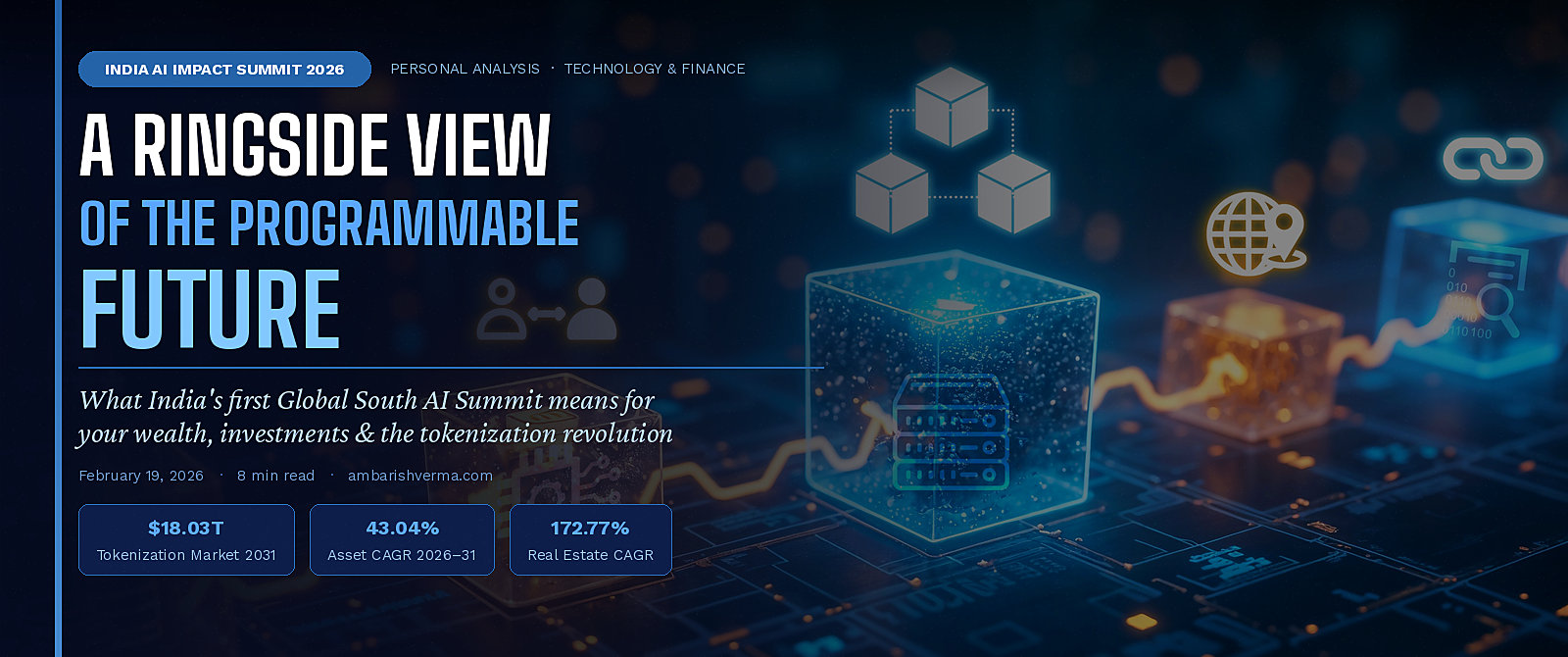
The global asset tokenization market is expected to grow from today’s levels to USD 18.03 trillion by 2031 — a compound annual growth rate of 43.04%.
Let that number sink in. For context, the entire market capitalisation of the Bombay Stock Exchange today is approximately USD 4.5 trillion. The tokenization market, within five years, is projected to be four times larger.
What Is Asset Tokenization — And Why Should You Care?
Asset tokenization is the process of converting ownership rights to real-world assets — property, gold, private credit, infrastructure, carbon credits — into digital tokens on a blockchain. These tokens can be bought, sold, fractionated, and traded 24/7 without traditional intermediaries.
The implications are profound. Consider three scenarios:
- A young professional in Lucknow can now co-own a fraction of a premium commercial property in Mumbai for ₹10,000, earning proportional rental income — something that would have been impossible without tokenization.
- A treasury manager at a mid-size bank in Hyderabad can use tokenized government securities as real-time collateral for overnight lending, eliminating the two-day settlement delays that tie up billions in idle capital.
- A retail investor nervous about inflation can buy a token backed by physical gold stored in a regulated vault — gaining gold’s safe-haven properties without the logistical headache of storage, transport, or counterparty risk.
These are not theoretical examples. They are live products being offered today by companies like Securitize, RealT, Paxos Gold (PAXG), Zoniqx, and Tether Gold (XAUT) — all of which we profile in depth in our report.
The Market Numbers: Staggering, But Grounded
Let me share some of the key projections from our research:
Global Asset Tokenization Market
Projected CAGR of 43.04% between 2026 and 2031, reaching USD 18.03 trillion. Three primary drivers: institutional demand for collateral mobility, the regulatory clarity brought by the US GENIUS Act (passed July 2025), and a demographic wave of under-40 investors seeking alternative asset access.
Real Estate Tokenization
This is the sleeper statistic of the decade: a projected CAGR of 172.77%, reaching USD 3.02 trillion by 2031. The reason for such explosive growth? Real estate has historically been the world’s largest asset class — over USD 326 trillion globally — yet participation has been limited by the tyranny of high minimum investments. Tokenization shatters that barrier entirely.
Gold Tokenization
With physical gold prices having surpassed USD 5,000 per ounce in 2025, tokenized gold markets surged 177% in market cap last year. By 2031, the gold tokenization market is projected to reach USD 38.94 billion. Tokens solve gold’s traditional friction points: storage, transport, insurance, and divisibility.
Supporting Infrastructure
The blockchain market — which provides the rails for all of this — is expected to grow to USD 318.59 billion by 2031 (CAGR: 53.51%). The crypto asset management market will reach USD 5.25 billion (CAGR: 21.66%). These are not speculative bets; they are infrastructure investments with institutional backing.
The AI Factor: From Smart Contracts to Agentic Finance
Here is where the India AI Impact Summit and our tokenization report converge most powerfully.
One of the most-discussed themes at the Summit is ‘Agentic AI’ — artificial intelligence systems that act autonomously, make decisions, and execute tasks without constant human oversight. In most industries, this is still largely aspirational. In finance, it is already happening.
Our report identifies ‘Agentic Finance’ as a defining future trend: AI agents that independently manage tokenized asset portfolios, rebalance allocations in response to market signals, optimise collateral across multiple lending platforms, and execute transactions on-chain — all at machine speed, without human intervention.
Paired with ‘atomic settlement’ — the elimination of traditional T+2 settlement delays in financial transactions — Agentic Finance represents a fundamental reimagining of how financial markets operate. Not evolutionary. Revolutionary.
India’s experience building large-scale digital public infrastructure — UPI, Aadhaar, ONDC — gives it a unique template for deploying AI-native financial systems at population scale. The Summit is proving that template to the world.
India’s Unique Position — And What It Means for Investors
There is a reason the AI Impact Summit chose India as its Global South host. India has already demonstrated, through UPI and Aadhaar, that it can build and deploy transformative digital infrastructure at scale, fast, and at low cost. The Summit is effectively India’s audition for a leading role in shaping how the world’s next financial infrastructure is built.
For tokenization specifically, India’s advantages are significant:
- A massive, mobile-first population hungry for new investment instruments beyond fixed deposits and gold jewellery
- A thriving fintech ecosystem with proven experience in digital payments and regulatory sandboxes
- Growing SEBI and RBI interest in regulated tokenization frameworks (watch this space)
- A young demographic that is, per our research, already driving fractional real estate investment adoption globally
The Asia-Pacific region, including India, is expected to be the fastest-growing market in global asset tokenization through 2031. The Summit is accelerating the institutional and policy infrastructure that will make that growth possible.
Access Our Research — Make Informed Decisions
If anything I have written today resonates with you — whether you are an investor, a financial professional, a technology leader, or simply someone curious about where the world is headed — I would strongly encourage you to read our full report.
‘The Sovereign Frontier: Global Asset Tokenization, Fractional Real Estate, and the Digital Gold Market 2026–2031’ is available now from NAVADHI Market Research Pvt Ltd. It is the most comprehensive market intelligence document available on this topic, and it was built for decision-makers, not spectators.
📥 Access the Report: https://www.navadhi.com/publications/sovereign-frontier-global-asset-tokenization-fractional-real-estate-and-digital-gold
Pricing starts at USD 650 for a Single User License. Site and Enterprise licenses are available for organisations.
Closing Thought: The Convergence Has Already Begun
The India AI Impact Summit 2026 is not just a diplomatic event. It is a signal. The world’s largest democracy, home to the world’s largest young population, is declaring that the next era of technology — and the financial systems built on top of it — will be shaped with inclusion, impact, and equity at their core.
Asset tokenization is one of the most concrete expressions of that vision. It takes the world’s largest, least accessible asset classes and makes them available to anyone with a smartphone and an internet connection.
The Summit is happening today. The tokenization revolution is already underway. The question is simply: are you paying attention?

Leave a Reply