Posts in "Research" category

Feeding the World Under Fire: What the Global Fertilizer Market Data Actually Tells Us in March 2026

Global Fertilizer Market Strategic Research Report 2026-2031
⚠  March 2026 Context: The Iran Conflict has emerged as a new geopolitical shock in the fertilizer market. The Strait of Hormuz — a corridor handling approximately 35% of global urea trade — is now directly exposed to conflict-driven disruption risk. This changes the near-term nitrogen market calculus in ways that no forecast published before February 2026 anticipated.

There is a sentence I keep coming back to in the research we published today:

 The global fertilizer landscape has shifted from a period of constrained equilibrium into a state of active structural rupture.

That is not marketing language. It is the most precise description of what the data shows when you build a rigorous bottom-up forecast of the global fertilizer market through 2031 — which is exactly what I have spent the past several months doing with the Navadhi research team.

Today we published the Global Fertilizer Market Strategic Research Report 2026–2031. This post is my personal perspective on what we found, why it matters beyond the fertilizer industry, and what I think the data is telling us about the broader food security and geopolitical landscape.

Why Fertilizers? Why Now?

Fertilizers are one of those industries that occupy a strange position in public consciousness — invisible when they work, catastrophic when they don’t. The 2022 fertilizer price crisis, triggered by Russia’s invasion of Ukraine removing two of the world’s three largest potash suppliers from Western supply chains, led to reduced application rates on hundreds of millions of hectares of farmland. Those reduced application rates translated into lower yields. Those lower yields contributed to the global food price inflation that disproportionately impacted the world’s poorest populations.

The fertilizer market is not a niche commodity sector. It is the physical substrate of global food security — and it is currently in a state of active geopolitical contestation. Understanding where it is heading is, I would argue, more strategically important than understanding where the semiconductor market or the electric vehicle market is heading, because fertilizer affects every human being on the planet through the price and availability of food.

That is why I wanted Navadhi to build this research properly, with a transparent, verified forecast model rather than recycled consensus estimates.

The Numbers: What the Forecast Actually Shows

$226B 2025 Base Year$283.03B 2031 Forecast3.90% CAGR$57B Market Added
Global Fertilizer Market Forecast 2025-2031 by Navadhi Market Research

The global fertilizer market grows from USD 226 billion in 2025 to USD 283.03 billion by 2031 — a 3.90% CAGR over a six-year forecast period. To put this in context: the market adds USD 57 billion in value, equivalent to approximately one additional Nutrien-scale company in revenue terms, over just six years.

But the aggregate number is almost the least interesting part of this forecast. The real story is in the four segments — and specifically in how differently each segment is growing and why.

The Four Segments: One Market, Four Completely Different Stories

Nitrogen — The Mature Giant Under Pressure

At USD 93.3 billion in 2026 and growing at 2.54% CAGR — the slowest segment — nitrogen fertilizers are experiencing the structural headwinds of a maturing market. IFFCO’s nano-urea technology, now scaling globally through licensing agreements, is demonstrating that equivalent yields can be achieved at half the conventional application rate. Enhanced-efficiency fertilizers with urease and nitrification inhibitors are gaining regulatory mandates in the EU. And now, the March 2026 Iran Conflict has introduced an acute near-term risk: the Strait of Hormuz, through which approximately 35% of global urea trade transits, is directly in the conflict zone.

For procurement teams managing nitrogen supply chains, this is not a theoretical risk. It is an operational planning emergency that requires immediate evaluation of alternative supply routes, contractual force majeure provisions, and strategic stockpile adequacy.

Continue Reading…

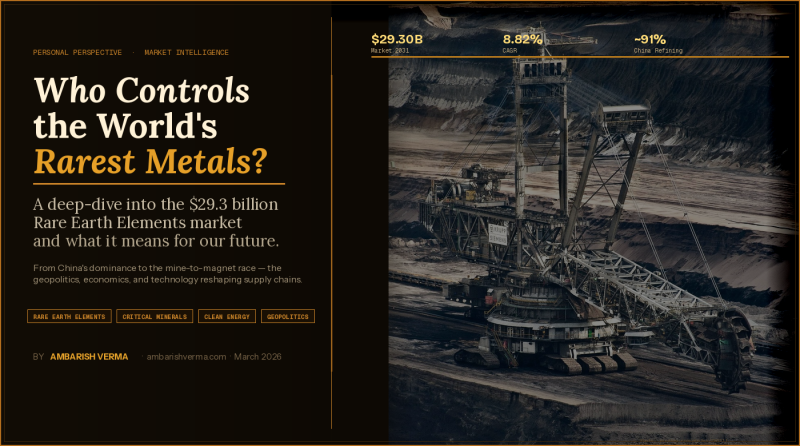
Who Controls the World’s Rarest Metals — And Why You Should Care

Global Rare Earth Elements Market Strategic Research Report 2026-2031

I’ll be honest with you: for most of my career, rare earth elements were a footnote. A line in a commodity table. Something the geological surveys tracked and the mining engineers worried about.

That changed for me when I started working on the research framework for what eventually became Navadhi’s Global Rare Earth Elements Market Strategic Research Report 2026–2031 . The deeper I went, the more I realised that this wasn’t a commodity story at all. It was a geopolitical story. A technology story. A story about who gets to build the future — and on whose terms.

In this post, I want to share what I’ve learned, why it matters far beyond the mining sector, and what I believe the market intelligence tells us about the decade ahead.

Let’s Start With What Rare Earths Actually Are

Despite the name, rare earth elements (REEs) are not geologically rare — cerium is more abundant in the Earth’s crust than copper. What makes them ‘rare’ is that they almost never occur in concentrated, economically mineable deposits. And what makes them strategically critical is that no other material does what they do.

A neodymium-iron-boron magnet (NdFeB) is the most powerful permanent magnet commercially available. It’s what makes your EV motor powerful enough to accelerate a 2-tonne vehicle from 0–60 in under 4 seconds while fitting in something the size of a large microwave oven. It’s what makes a 3-megawatt offshore wind turbine work without a gearbox. It’s what makes the radar in an F-35 function with the precision it does.

 There are 17 rare earth elements. The ones that really matter strategically — the ones that are genuinely difficult to source outside China — fit on one hand: neodymium, praseodymium, dysprosium, terbium, and samarium.

The Market in Numbers: Bigger Than Most People Realise

$17.6B Market 2025 (REO basis)$29.30B Projected 20318.82% CAGR9.96% Magnets CAGR

The numbers above come from the Navadhi report, which measures the market on a Rare Earth Oxide (REO) equivalent basis — the internationally accepted standard. This isn’t a small, specialist commodity market. At USD 17.6 billion and growing to USD 29.3 billion by 2031, it is larger than the entire global cobalt market and approaches the size of the lithium market.

The growth engine is permanent magnets. That segment is growing at 9.96% annually — faster than the overall market — because of the relentless acceleration in EV production and offshore wind deployment. When analysts talk about the energy transition, REEs are the physical enabling material that makes that transition real.

The China Problem — And Why It’s Getting Worse

Here is the central structural fact of this market: China controls approximately 60% of global rare earth mining and roughly 85–91% of global separation and refining capacity. For heavy rare earths like dysprosium and terbium, that share approaches 100%.

Continue Reading…

India’s MRO Moonshot: How Bengaluru, Agentic AI, and a 14-Year Backlog Are Rewriting the Rules of Global Aviation Maintenance

Global Commercial Aviation MRO Market Forecast

Somewhere on a tarmac in Bengaluru, an ageing narrowbody is waiting. Its operator ordered a replacement five years ago. That replacement will not arrive for another nine. In the meantime, the aircraft must fly — and it must be maintained. Welcome to the defining commercial reality of global aviation in 2026, and the single largest unmet business opportunity I have come across in the past decade. Last month, I shared the macro view on LinkedIn — the numbers behind the global Commercial Aviation MRO market on its way to USD 132.58 billion by 2031. Today, I want to go deeper on the story that excites me most from our newly published Global Commercial Aviation MRO Strategic Research Report 2026–2031: the India chapter. Because what is happening to Indian aviation maintenance is not an emerging market footnote. It is a reordering of the global aerospace map.

The Inversion: When Waiting for New Becomes More Expensive Than Fixing Old

To understand India’s MRO opportunity, you first need to understand the global paradox that created it.

Airbus and Boeing are running backlogs that, in some categories, extend to 14 years. The GTF engine issues alone have grounded hundreds of aircraft. Supply chain bottlenecks — from titanium to fasteners — have made aircraft production slower, not faster, than the previous decade. Airlines that expected fleet renewal are instead operating aircraft well into their third decade of service.

The strategic logic of the entire MRO industry has inverted. You are no longer managing maintenance until the new plane arrives. You are engineering a 30-year asset life for aircraft originally designed for 20.

This is not a temporary disruption. Our research indicates this structural dynamic will persist through the entire forecast period of 2026–2031. And it means MRO has moved from being a cost centre — something airlines tolerate — to being a strategic guarantor of flight capacity. The airline that cannot maintain its fleet cannot fly. In a world of 14-year delivery queues, there are no alternatives.

The India Numbers: A Super-Hub in the Making

Let me put the India-specific data on the table:

USD 4 Billion  — projected size of India’s MRO market by 2031

8.91% CAGR  — India’s growth rate, outpacing the global 6.57% average

2× Fleet Expansion  — India’s aircraft order backlog exceeds double its current in-service fleet

100% FDI  — India now permits full foreign direct investment in MRO facilities

These numbers matter individually. Together, they describe an inflection point. India is not incrementally growing its MRO base — it is building the structural conditions for a generational hub.

The comparison that keeps coming to mind is Singapore in the 1980s. When SIA Engineering (SIAEC) was built, the scepticism was real: could a small Southeast Asian nation become a world-class aviation maintenance hub? Today, SIAEC is one of the ten most important MRO providers on earth. The SIAEC-Air India partnership in Bengaluru is not a coincidence of convenience — it is a deliberate transfer of that playbook to the subcontinent.

Continue Reading…

The Vegetables Are Lying to You — And I’m Building FoodScanLab™ to Stop That

The Vegetables Are Lying to You — And I'm Building FoodScanLab ™ to Stop That

There’s a particular kind of dread that comes not from dramatic disasters, but from the slow revelation that something you trusted completely was never safe to begin with.

That’s the feeling I had reading the Central Pollution Control Board’s latest findings out of Bengaluru. And if you eat vegetables — which I assume you do — it should give you pause too.


What the Data Says (And What It Means for Your Dinner Table)

In a CPCB study whose results surfaced in prominent Indian news outlets since yesterday, researchers tested 72 vegetable samples collected from markets across Bengaluru in FSSAI-approved laboratories. The findings were stark: 26% of samples — roughly one in four — exceeded permissible limits for lead contamination.

Nineteen samples came back positive. And among them, some vegetables carrying an “organic” label showed lead levels 20 times above safety thresholds. Banned pesticides including monocrotophos were also detected in samples.

This wasn’t the first alarm. The Environment Management and Policy Research Institute (EMPRI) had already published findings in 2023 after testing 400 samples of 10 vegetables — brinjal, tomato, capsicum, beans, carrot, green chilli, onion, potato, spinach, and coriander — from 20 stores across the city, spanning everything from premium supermarkets to local markets to organic stores and Hopcoms. They found cadmium levels in coriander and spinach reaching 52.30 mg per kg against a permissible limit of 0.2 mg per kg. Nickel exceeded permissible levels at 67.9 mg per kg in some samples.

The National Green Tribunal took suo motu cognizance. The CPCB was directed to verify the situation. Committees were proposed. Reports were filed. And through all of it, the vegetables kept moving through the supply chain, landing on plates across one of India’s most educated, health-conscious, and economically prosperous cities.

Nobody at the vegetable stall knew. Nobody at the supermarket checkout knew. The consumer certainly didn’t know.

Continue Reading…

India AI Impact Summit 2026: A Ringside View of the Programmable Future and What It Means for Your Wealth

India AI Impact Summit 2026: A Ringside View of the Programmable Future — And What It Means for Your Wealth

I’ll be honest with you — when I first started tracking the India AI Impact Summit 2026 a few months ago, I thought it would be another well-intentioned gathering of global leaders making non-binding pledges, posing for cameras, and flying home. I’ve attended enough conferences to be cynical.

But what is unfolding this week at Bharat Mandapam in New Delhi — the first global AI summit ever hosted in the Global South — is genuinely different. And as someone who has spent years tracking market trends at the intersection of technology and finance, I believe what is happening in these rooms directly connects to one of the most significant wealth creation opportunities of the next decade.

Let me walk you through what’s happening, what it means, and why the timing of our newly published asset tokenization report from NAVADHI could not be more relevant.

The Summit That Changed the AI Conversation

The India AI Impact Summit 2026 is the fourth instalment of a global AI summit series that began at Bletchley Park, England, in November 2023. Each edition has reflected the geopolitical and technological mood of its moment:

  • Bletchley Park 2023 — 28 nations, cautious, focused entirely on frontier AI safety risks
  • Seoul 2024 — broader participation, started integrating deployment and governance
  • Paris 2025 — transatlantic tensions on AI regulation, dominated by JD Vance’s warning against ‘excessive regulation’
  • New Delhi 2026 — 100+ nations, 250,000 expected attendees, a decisive pivot to measurable impact

India’s choice of theme — ‘Impact’ over ‘Safety’ — is a deliberate statement. Prime Minister Modi announced this Summit at the Paris gathering specifically to reframe the conversation around what AI can do, not just what it might risk.

Inaugurating the Summit today, PM Modi described AI as comparable in civilisational importance to the discovery of fire and the invention of wireless communication. That framing matters — it sets the political will behind a technology that will touch every industry, every market, and ultimately every investment thesis.

Continue Reading…

State of Onions – Reasons for Rising Prices and Solutions for Indian Market

Onions - A Love Hate Story for Indian Consumers

Onion is quintessential commodity which is integral part of everyday diet of most of the Indians. It’s also a commodity which is equally used by a daily wage labour as a main course with pain roti (bread) or as part of salad and various Indian curries by rich and famous eating in star hotels. It’s also the only vegetable which as the power to overthrow Governments.

Onion retail and wholesale prices in Indian market has soared in the past few months. According to recent news reports, the prices are expected to touch INR 100/Kg. making onions far costlier than most of the pulses which contain more nutrients than onions.

To analyse the increase in the price of onions we will have to first understand the trading pattern for this commodity.

The export-import (EXIM) scenario of onions is highly skewed in the favour of exports as explained below:

EXIM Scenario of Onions in India

1.1 Export Scenario for Onions

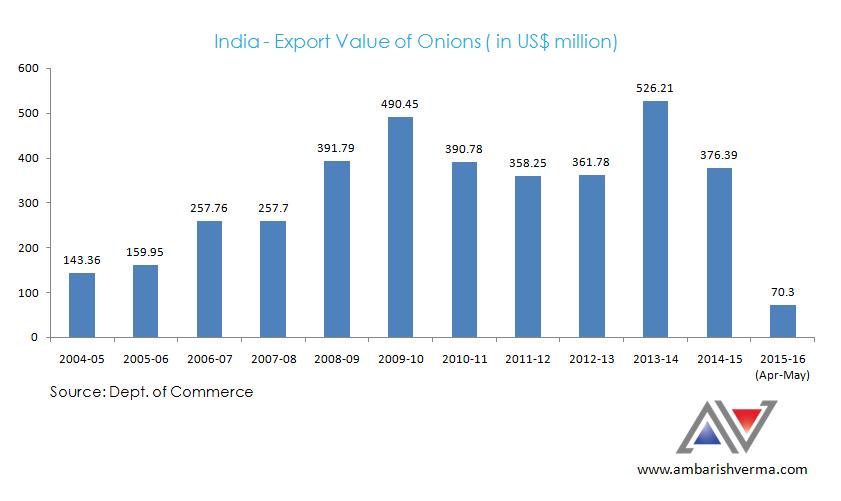
India’s export of onions was at US$ 143.36 million in 2004-05 which rose to US$ 376.39 million in 2014-15. India exported US$ 3.71 billion worth of onions during this period.

India - Export Value of Onions (in US$ million)
India – Export Value of Onions (in US$ million)

Continue Reading…

India’s 69th Independence Day – Opportunities and Challenges Ahead

Ashoka Pillar

India just celebrated it’s 69th Independence day with a lot of fervor. It’s definitely a moment to celebrate for all Indians across the world but the country faced greater challenges ahead. If tackled properly then these challenges can be converted into opportunities. Without further ado let’s dive right into them.

Rising Population

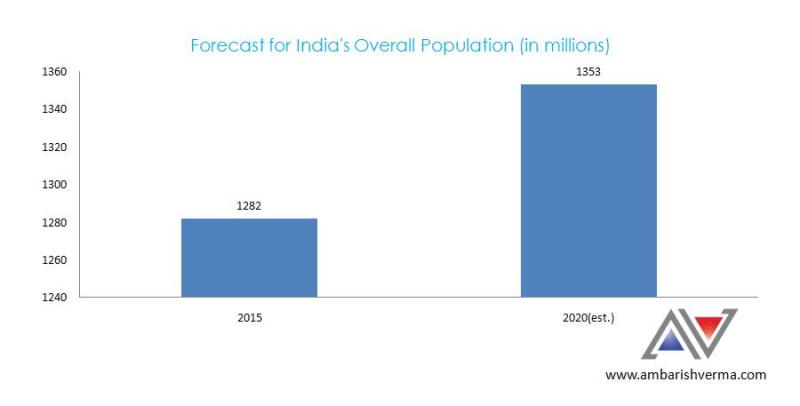
According to the United Nations, estimated population of India is expected to cross 1353 million by year 2020. The current estimate of the population by end of 2015 is expected to touch 1282 million.

Forecast of India's Overall Population (in millions)
Forecast of India’s Overall Population (in millions)

On one hand this creates a problem because we are running out of natural resources to support such a large population. But if looked at from human resource point of view this presents huge opportunities as this very same population, if managed and skilled properly; can propel India to become leading nation in every sector be it business, agriculture, science and technology etc.

Continue Reading…