

Somewhere on a tarmac in Bengaluru, an ageing narrowbody is waiting. Its operator ordered a replacement five years ago. That replacement will not arrive for another nine. In the meantime, the aircraft must fly — and it must be maintained. Welcome to the defining commercial reality of global aviation in 2026, and the single largest unmet business opportunity I have come across in the past decade. Last month, I shared the macro view on LinkedIn — the numbers behind the global Commercial Aviation MRO market on its way to USD 132.58 billion by 2031. Today, I want to go deeper on the story that excites me most from our newly published Global Commercial Aviation MRO Strategic Research Report 2026–2031: the India chapter. Because what is happening to Indian aviation maintenance is not an emerging market footnote. It is a reordering of the global aerospace map.
The Inversion: When Waiting for New Becomes More Expensive Than Fixing Old
To understand India’s MRO opportunity, you first need to understand the global paradox that created it.
Airbus and Boeing are running backlogs that, in some categories, extend to 14 years. The GTF engine issues alone have grounded hundreds of aircraft. Supply chain bottlenecks — from titanium to fasteners — have made aircraft production slower, not faster, than the previous decade. Airlines that expected fleet renewal are instead operating aircraft well into their third decade of service.
The strategic logic of the entire MRO industry has inverted. You are no longer managing maintenance until the new plane arrives. You are engineering a 30-year asset life for aircraft originally designed for 20.
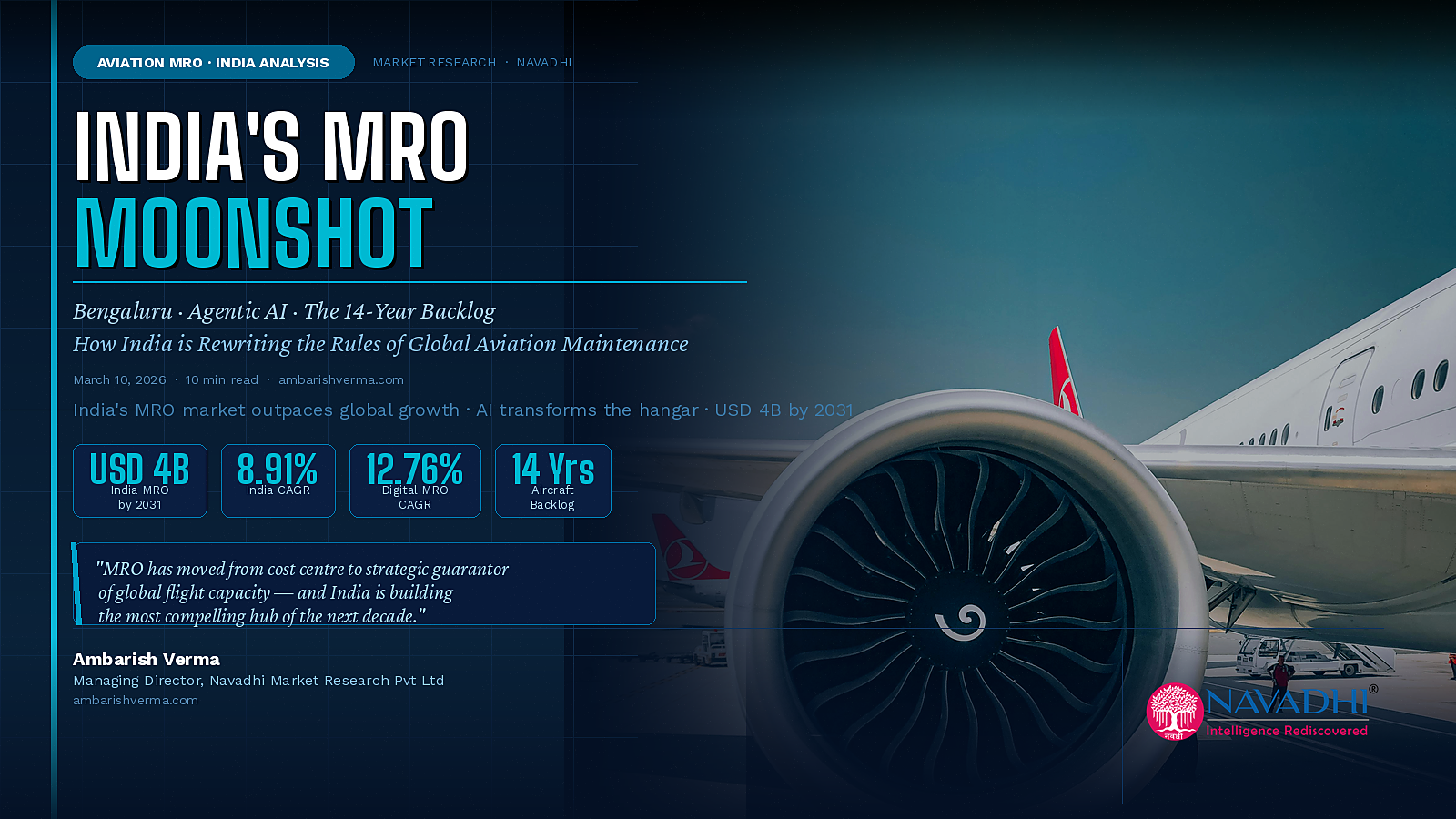
This is not a temporary disruption. Our research indicates this structural dynamic will persist through the entire forecast period of 2026–2031. And it means MRO has moved from being a cost centre — something airlines tolerate — to being a strategic guarantor of flight capacity. The airline that cannot maintain its fleet cannot fly. In a world of 14-year delivery queues, there are no alternatives.
The India Numbers: A Super-Hub in the Making
Let me put the India-specific data on the table:
USD 4 Billion — projected size of India’s MRO market by 2031
8.91% CAGR — India’s growth rate, outpacing the global 6.57% average
2× Fleet Expansion — India’s aircraft order backlog exceeds double its current in-service fleet
100% FDI — India now permits full foreign direct investment in MRO facilities
These numbers matter individually. Together, they describe an inflection point. India is not incrementally growing its MRO base — it is building the structural conditions for a generational hub.
The comparison that keeps coming to mind is Singapore in the 1980s. When SIA Engineering (SIAEC) was built, the scepticism was real: could a small Southeast Asian nation become a world-class aviation maintenance hub? Today, SIAEC is one of the ten most important MRO providers on earth. The SIAEC-Air India partnership in Bengaluru is not a coincidence of convenience — it is a deliberate transfer of that playbook to the subcontinent.
The AI Angle: Why This Is Different From Every Previous MRO Growth Story
I have been spending a lot of time thinking about the intersection of artificial intelligence and industrial operations — it was a thread running through the India AI Impact Summit 2026 in New Delhi that I wrote about recently. The MRO industry is one of the most compelling real-world arenas where this intersection becomes concrete and consequential.
Here is the problem: the global MRO industry is facing a severe and structural shortage of skilled maintenance technicians. Training a certified aircraft maintenance engineer takes years. Retirements are accelerating. The pipeline is insufficient. No country — including India — can simply hire its way out of this.
This is precisely where Agentic AI and digital twins are transforming the industry from a labour-intensive craft into a data-driven industrial operation.
What digital MRO actually means in practice:
- AI-driven predictive health monitoring analyses real-time engine sensor data to flag anomalies before they become AOG (Aircraft on Ground) events — shifting maintenance from reactive to anticipatory
- Digital twins of engines and airframes allow engineers to simulate wear patterns and failure scenarios without disassembling physical components
- Agentic AI systems autonomously manage parts ordering, slot scheduling, and regulatory compliance documentation — freeing technicians for high-skill physical work
- Computer vision tools perform visual inspections of fuselage, landing gear, and engine components with accuracy exceeding human inspection in controlled conditions
Our report forecasts that the Digital MRO Software segment will grow at 12.76% CAGR through 2031 — the fastest-growing segment in the entire MRO landscape. This is not surprising. The digital layer is where the leverage is. A single AI system that reduces average Engine Shop Visit duration by 10% creates more value than adding 100 technicians.
India has a structural advantage here that is rarely discussed: its deep software engineering talent base. The country that gave the world enterprise IT outsourcing is now positioned to build the world’s most sophisticated digital MRO infrastructure.
The Engine Question: Where the Real Money Is
If you are allocating capital or building a business in MRO, the segment-level breakdown matters enormously. Our report covers five segments: Line Maintenance, Component MRO, Engine MRO, Airframe Heavy Maintenance, and Digital MRO Software.
Engine MRO is the largest segment — it commands the highest market share, and our data indicates it will maintain its leadership position through 2031, growing at 6.92% CAGR. The reason is straightforward: we are in the middle of the largest high-thrust engine remediation cycle in aviation history.
The GTF (Geared Turbofan) engine issues affecting the Airbus A320neo family have placed extraordinary demands on engine MRO capacity globally. Hundreds of aircraft have been grounded for extended inspections. Engine shop capacity — measured in slots at certified facilities — is fully booked. Operators are paying premium rates to jump queues.
This is a defining moment for India. Engine MRO is the most complex, most capital-intensive, and highest-value segment of the maintenance ecosystem. It is also the segment where India has historically been most dependent on overseas facilities — flying engines to Singapore, the Middle East, or Germany for heavy maintenance. The strategic opportunity now is clear: bring those engine shop visits home.
Two Investment Playbooks for India MRO
For investors and corporate strategists assessing the India MRO opportunity, our report outlines two distinct and non-mutually-exclusive investment models:
Model 1: The Strategic Partnership Approach (The SIAEC-Air India Blueprint)
Partner with a domestic Indian carrier or MRO provider to establish a joint venture, leveraging the foreign partner’s technical capability and certification base alongside the Indian partner’s regulatory relationships, workforce, and market access.
The SIAEC-Air India joint venture in Bengaluru is the reference transaction. SIAEC brings decades of technical excellence. Air India brings a captive maintenance demand base and local operational knowledge. The combined entity captures both the guaranteed internal demand and the third-party market.
This model de-risks market entry, accelerates regulatory approvals, and builds local capability faster. The trade-off is shared economics and the complexity of joint governance.
Model 2: The Direct FDI / OEM-Captive Approach
With India now permitting 100% FDI in MRO, an international OEM or independent MRO provider can establish a wholly-owned facility targeting third-party market demand — not just captive airline work.
This model offers full control over operations, IP, and margins. It requires heavier upfront capital and a longer horizon to build the customer base. The payoff for those who move early is the ability to shape India’s MRO certification standards, talent pipelines, and technology adoption before the market matures.
The analogy I would use: the MRO investor who enters India’s engine overhaul market in 2026 occupies the same strategic position as the data centre developer who entered India’s colocation market in 2010. The infrastructure buildout is just beginning, and capacity will be undersupplied for the entire decade.
The USM Revolution: Turning Scarcity Into a Business Model
One of the most overlooked themes in our report — and arguably the most interesting for entrepreneurs — is the rise of Used Serviceable Material (USM) as a strategic business category.
With new aircraft parts facing the same supply chain bottlenecks as new aircraft themselves, MRO operators are turning to USM — serviceable components removed from retired or parted-out aircraft — as a legitimate and increasingly critical supply source.
USM is not salvage. When certified and documented correctly, USM parts meet the same regulatory standards as new-manufacturing parts and can be priced at 40–60% of OEM list price. For an airline trying to keep a 25-year-old narrowbody flying safely and economically, certified USM is not a compromise. It is the answer.
Pair this with additive manufacturing — where certain non-flight-critical components can now be 3D-printed to airworthy standards — and you have the outline of a circular economy for aerospace components that would have been unimaginable ten years ago. The leaders of 2031 will be the MRO providers that industrialise USM and additive manufacturing before their competitors.
What This Report Covers
The Global Commercial Aviation MRO Strategic Research Report 2026–2031 from Navadhi Market Research provides:
- Full market forecast through 2031 for the global MRO market and all five segments (Line Maintenance, Component MRO, Engine MRO, Airframe Heavy Maintenance, Digital MRO Software)
- Detailed India MRO chapter: market forecast, growth drivers, investment strategy analysis (direct FDI vs. strategic partnership), and full PESTLE framework
- Competitive landscape and SWOT analysis for 10 leading global MRO providers: Lufthansa Technik, GE Aerospace, ST Engineering Aerospace, AFI KLM E&M, HAECO Group, Safran Aircraft Engines, Delta TechOps, AAR Corp., Turkish Technic, and SIA Engineering Company (SIAEC)
- Capability matrix and strategic positioning analysis for all covered players
- PESTLE and SWOT analysis for the global MRO market
- 10 key pain points facing the industry — from technician shortages to OEM vs. independent provider competition
- Future trends analysis including Agentic AI adoption, digital twins, USM professionalisation, and additive manufacturing
At 38 pages and published on March 10, 2026, it is the most current and comprehensive view of the global and India MRO landscape available today.
The Bottom Line
Aviation MRO is not a cyclical industry waiting for the next recovery. It is a structural growth market being reshaped simultaneously by three powerful forces: the longest aircraft delivery backlog in history, the deepest digital transformation the industry has ever seen, and the emergence of India and the Middle East as the new centres of global aerospace gravity.
For investors, executives, and entrepreneurs operating in this space, the decisions made in the next 24 months will determine competitive positioning for the rest of the decade. The market does not wait for conviction to arrive at its own pace.
I hope this piece gives you a useful frame. And I hope the report gives you the data to act on it.
Download the report:
Global Commercial Aviation MRO Strategic Research Report 2026–2031 — navadhi.com


Leave a Reply