


I’ll be honest with you: for most of my career, rare earth elements were a footnote. A line in a commodity table. Something the geological surveys tracked and the mining engineers worried about.
That changed for me when I started working on the research framework for what eventually became Navadhi’s Global Rare Earth Elements Market Strategic Research Report 2026–2031 . The deeper I went, the more I realised that this wasn’t a commodity story at all. It was a geopolitical story. A technology story. A story about who gets to build the future — and on whose terms.
In this post, I want to share what I’ve learned, why it matters far beyond the mining sector, and what I believe the market intelligence tells us about the decade ahead.
Let’s Start With What Rare Earths Actually Are
Despite the name, rare earth elements (REEs) are not geologically rare — cerium is more abundant in the Earth’s crust than copper. What makes them ‘rare’ is that they almost never occur in concentrated, economically mineable deposits. And what makes them strategically critical is that no other material does what they do.
A neodymium-iron-boron magnet (NdFeB) is the most powerful permanent magnet commercially available. It’s what makes your EV motor powerful enough to accelerate a 2-tonne vehicle from 0–60 in under 4 seconds while fitting in something the size of a large microwave oven. It’s what makes a 3-megawatt offshore wind turbine work without a gearbox. It’s what makes the radar in an F-35 function with the precision it does.
| There are 17 rare earth elements. The ones that really matter strategically — the ones that are genuinely difficult to source outside China — fit on one hand: neodymium, praseodymium, dysprosium, terbium, and samarium. |
The Market in Numbers: Bigger Than Most People Realise
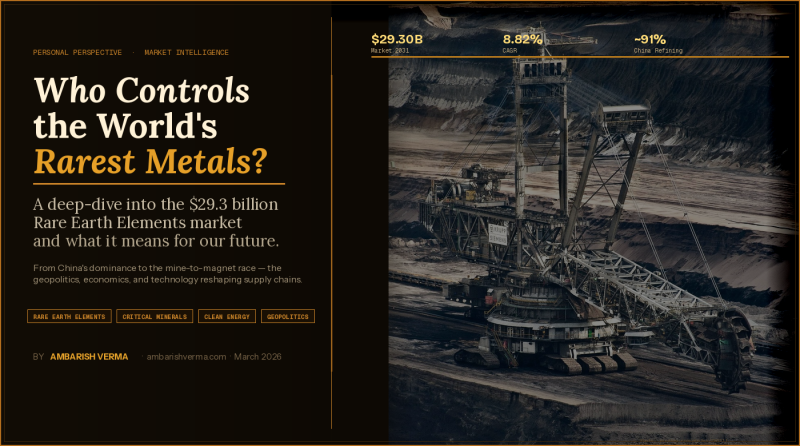
| $17.6B Market 2025 (REO basis) | $29.30B Projected 2031 | 8.82% CAGR | 9.96% Magnets CAGR |
The numbers above come from the Navadhi report, which measures the market on a Rare Earth Oxide (REO) equivalent basis — the internationally accepted standard. This isn’t a small, specialist commodity market. At USD 17.6 billion and growing to USD 29.3 billion by 2031, it is larger than the entire global cobalt market and approaches the size of the lithium market.
The growth engine is permanent magnets. That segment is growing at 9.96% annually — faster than the overall market — because of the relentless acceleration in EV production and offshore wind deployment. When analysts talk about the energy transition, REEs are the physical enabling material that makes that transition real.
The China Problem — And Why It’s Getting Worse
Here is the central structural fact of this market: China controls approximately 60% of global rare earth mining and roughly 85–91% of global separation and refining capacity. For heavy rare earths like dysprosium and terbium, that share approaches 100%.