


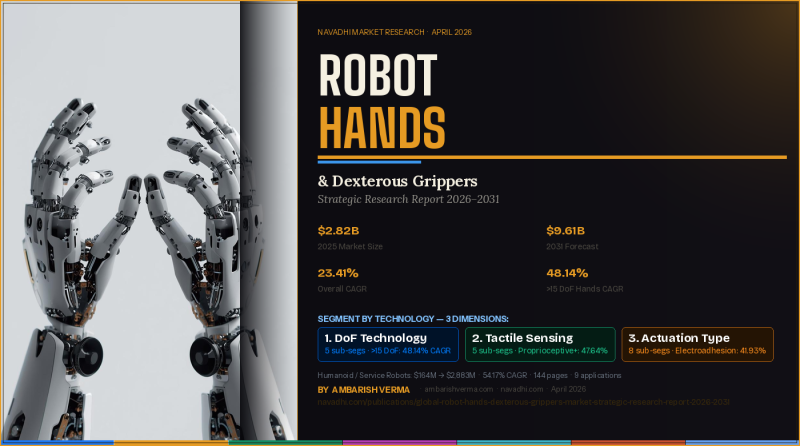
USD 2.82B today. USD 9.61B by 2031. But the number that tells the real story is 23.41% – the market CAGR that only makes sense when you understand why this market is structured the way it is.
When I set out to scope the Global Robot Hands / Dexterous Grippers market research that Navadhi has just published, the first question I had to answer was: what actually is a robot hand?
Is a two-jaw pneumatic gripper that has been doing the same pick-and-place task in an automotive plant for twelve years a ‘robot hand’? Is a tendon-driven 16-DoF anthropomorphic hand on a humanoid robot a ‘gripper’? What about a soft silicone pouch that inflates around a strawberry to pick it without bruising it?
The answer, which the report makes explicit, is that all of these are part of the same market – because they all solve the same problem: how does a robot interact with the physical world? The taxonomy of how they solve that problem is what makes this market fascinating and, once you understand it, predictable.
The Three-Dimensional Technology Framework
The Navadhi report segments the technology across three independent axes, which I think is the right analytical framework for understanding this market:
Axis 1: Degrees of Freedom (DoF) – How Much Can It Move?
This is the most intuitive dimension. A 2-DoF gripper opens and closes. A 6-DoF adaptive gripper has multiple fingers that can adopt different configurations. A 15-DoF dexterous hand has independent control of each finger segment. A >15 DoF full dexterous hand has enough joint independence to replicate human hand motion.
The >15 DoF segment is growing at 48.14% CAGR – by far the fastest in the market. The reason is arithmetic: AGIBOT shipped 5,168 humanoid robots in 2025. Each requires two hands. Each hand is a >15 DoF system. Every additional humanoid unit shipped creates two units of >15 DoF demand. The Industrial Grippers segment (primarily 2–3 DoF) remains 67.62% of the total market in 2025 and grows at 11.79% CAGR – the market is not replacing industrial grippers with humanoid hands, it is adding humanoid dexterous hands on top of the industrial base.
Axis 2: Tactile / Sensing – Can It Feel?
This dimension is the one most people in the industry underestimate. The limiting factor in dexterous manipulation is not the number of joints – it is the quality of sensory feedback. A human hand has approximately 17,000 touch receptors per square centimetre of fingertip. Current commercial tactile sensors are nowhere near that resolution, but the trajectory is improving faster than the mechanical joint count.
The report segments sensing across five tiers from no sensing (standard industrial) to Proprioceptive + Multi-modal – which integrates joint torque, fingertip force arrays, and vision simultaneously. The top tier grows at 47.64% CAGR because it is the sensing configuration required for humanoid robots to operate safely in unstructured environments. Google DeepMind’s collaboration with Shadow Robot on DEX-EE directly targets this capability. The insight I keep returning to: the market has always had mechanically capable hands. What it has lacked is the sensory infrastructure to make those hands useful.
Axis 3: Actuation / Manipulation – What Makes It Move?
The eight actuation technologies in this report reveal a market in the middle of a major transition. The installed base is pneumatic – and it will remain pneumatic for industrial applications for at least the next decade. But the growth is in electric, tendon-driven, and emerging technologies.
Tendon/cable-driven actuation grows at 40.71% CAGR because tendons enable high DoF, lightweight fingers with remote actuation – the biological blueprint that Shadow Robot and INSPIRE-ROBOTS have commercialised at scale. Electroadhesion/gecko-inspired grows at 41.93% CAGR from a smaller base – this is the technology for gripping surfaces that cannot be clamped, vacuumed, or magnetised: semiconductor wafers, thin glass, CFRP panels, flexible displays. The semiconductor industry’s transition to larger, more delicate wafer formats is the specific demand driver.
The Application That Changes Everything
The application segment data tells the most striking story in the report. In 2025, Automotive Manufacturing is the largest segment at 34.6% market share. Humanoid/Service Robots is the sixth-largest at USD 164 million. By 2031, Humanoid/Service Robots is the largest segment at USD 2,883 million, growing at 54.17% CAGR. It goes from sixth to first in six years.
The enabling event is the cost curve. A USD 3,000–8,000 commercial dexterous hand (available today from INSPIRE-ROBOTS) is cheap enough to include in a USD 25,000–40,000 humanoid platform for industrial customers. A sub-USD 1,000 commodity dexterous hand (targeted by 2029) is cheap enough to include in a consumer humanoid robot. The market is not waiting for a technological breakthrough. It is waiting for a cost curve to reach a threshold – and that threshold is already visible on the horizon.
About the Report
Global Robot Hands / Dexterous Grippers Market Strategic Research Report 2026–2031 – Navadhi Market Research. 144 pages. USD 2.82B (2025) → USD 9.61B (2031) at 23.41% CAGR. Three technology dimension segments: DoF (5 sub-segments), Tactile/Sensing (5 sub-segments), Actuation (8 sub-segments). Three type segments. Nine application verticals. 11 company SWOT analyses.
📄 Report: marketresearchreports.com/navadhi/global-robot-hands…
🌐 Navadhi: navadhi.com/publications/global-robot-hands…