


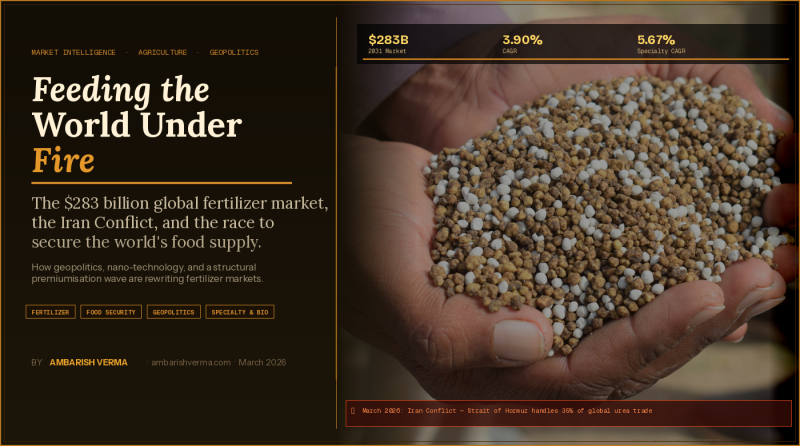
| ⚠ March 2026 Context: The Iran Conflict has emerged as a new geopolitical shock in the fertilizer market. The Strait of Hormuz — a corridor handling approximately 35% of global urea trade — is now directly exposed to conflict-driven disruption risk. This changes the near-term nitrogen market calculus in ways that no forecast published before February 2026 anticipated. |
There is a sentence I keep coming back to in the research we published today:
| The global fertilizer landscape has shifted from a period of constrained equilibrium into a state of active structural rupture. |
That is not marketing language. It is the most precise description of what the data shows when you build a rigorous bottom-up forecast of the global fertilizer market through 2031 — which is exactly what I have spent the past several months doing with the Navadhi research team.
Today we published the Global Fertilizer Market Strategic Research Report 2026–2031. This post is my personal perspective on what we found, why it matters beyond the fertilizer industry, and what I think the data is telling us about the broader food security and geopolitical landscape.
Why Fertilizers? Why Now?
Fertilizers are one of those industries that occupy a strange position in public consciousness — invisible when they work, catastrophic when they don’t. The 2022 fertilizer price crisis, triggered by Russia’s invasion of Ukraine removing two of the world’s three largest potash suppliers from Western supply chains, led to reduced application rates on hundreds of millions of hectares of farmland. Those reduced application rates translated into lower yields. Those lower yields contributed to the global food price inflation that disproportionately impacted the world’s poorest populations.
The fertilizer market is not a niche commodity sector. It is the physical substrate of global food security — and it is currently in a state of active geopolitical contestation. Understanding where it is heading is, I would argue, more strategically important than understanding where the semiconductor market or the electric vehicle market is heading, because fertilizer affects every human being on the planet through the price and availability of food.
That is why I wanted Navadhi to build this research properly, with a transparent, verified forecast model rather than recycled consensus estimates.
The Numbers: What the Forecast Actually Shows
| $226B 2025 Base Year | $283.03B 2031 Forecast | 3.90% CAGR | $57B Market Added |
The global fertilizer market grows from USD 226 billion in 2025 to USD 283.03 billion by 2031 — a 3.90% CAGR over a six-year forecast period. To put this in context: the market adds USD 57 billion in value, equivalent to approximately one additional Nutrien-scale company in revenue terms, over just six years.
But the aggregate number is almost the least interesting part of this forecast. The real story is in the four segments — and specifically in how differently each segment is growing and why.
The Four Segments: One Market, Four Completely Different Stories
Nitrogen — The Mature Giant Under Pressure
At USD 93.3 billion in 2026 and growing at 2.54% CAGR — the slowest segment — nitrogen fertilizers are experiencing the structural headwinds of a maturing market. IFFCO’s nano-urea technology, now scaling globally through licensing agreements, is demonstrating that equivalent yields can be achieved at half the conventional application rate. Enhanced-efficiency fertilizers with urease and nitrification inhibitors are gaining regulatory mandates in the EU. And now, the March 2026 Iran Conflict has introduced an acute near-term risk: the Strait of Hormuz, through which approximately 35% of global urea trade transits, is directly in the conflict zone.
For procurement teams managing nitrogen supply chains, this is not a theoretical risk. It is an operational planning emergency that requires immediate evaluation of alternative supply routes, contractual force majeure provisions, and strategic stockpile adequacy.