
Posts in "Food Security" tag

Beyond the Flame: The Market That Will Replace LPG in Your Kitchen

Global LPG Alternatives Market Strategic Research Report 2026-2031

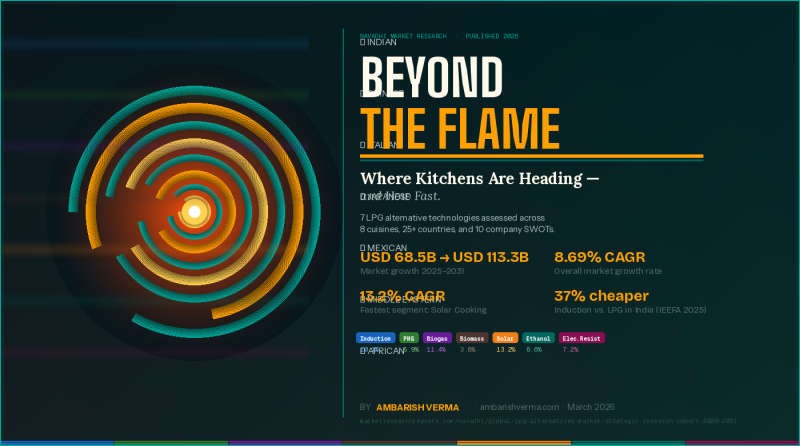
A global market growing at 8.69% annually. Seven competing technologies. Eight cuisine traditions with different needs. One very consequential question: what happens when the world’s 3.5 billion LPG users need an alternative?

I did not expect a market research project to make me question how I cook.

When I started building Navadhi’s Global LPG Alternatives Market report, I assumed it would be a clean energy transition story – the kind where solar and induction are obviously better and the only question is how fast adoption happens. What I found instead was considerably more complicated, more culturally interesting, and in certain segments more commercially urgent than I anticipated.

The urgency is partly the Iran War. On February 28, 2026, US-Israel strikes on Iran effectively closed the Strait of Hormuz – through which approximately 35% of globally traded LPG transits. LPG prices surged 22–35% in 19 days. In India, Indonesia, and the Philippines, physical cylinder shortages appeared before price signals did. This is not a commodity price event. It is a physical supply architecture failure. The global food system is more dependent on a 33-kilometre-wide waterway than most people – including most policymakers – realised.

But the Iran War is an accelerant, not the cause. The cause is structural: LPG’s cost and availability model was already under pressure from economics (induction is 37% cheaper than LPG in India at 2025 prices), from regulation (EU gas appliance bans, India’s PNG expansion mandate), from technology (solar cooker costs collapsing along a trajectory that mirrors solar panels), and from the demographic reality that the world’s fastest-growing LPG-dependent populations – in Sub-Saharan Africa and South and Southeast Asia – are also the populations for whom LPG price volatility is most catastrophically disruptive.

What We Found: USD 68.5 Billion LPG Alternatives Market in 2025 Growing to USD 113.3 Billion by 2031

The global LPG Alternatives market – defined as all cooking fuel solutions and cooking equipment specifically designed to replace LPG in households, commercial kitchens, and institutional food service – was worth USD 68.5 billion in 2025. Our forecast puts it at USD 113.3 billion by 2031, a CAGR of 8.69%. That growth rate places it among the fastest-growing market segments in the global energy and appliance landscape.

The growth is not evenly distributed. The fastest-growing segment is Solar Cooking (13.2% CAGR) – driven by the cost collapse of parabolic and evacuated-tube solar cookers as Chinese manufacturing applies the same learning curve model that reduced solar panel costs 90% over a decade. The largest segment is Electric Induction Cooking (growing at 10.1% CAGR by 2031) – driven by a combination of LPG price economics, regulatory mandates in Europe, and the progressive resolution of the culinary technique barriers that previously limited adoption in Asian markets.

The most intellectually interesting segment is Biogas and Biomethane (11.4% CAGR), because it is simultaneously a rural household cooking solution (family biogas digesters in India and Kenya converting agricultural waste to cooking fuel) and an urban infrastructure play (EU biomethane grid injection reaching 35 bcm by 2030). When biomethane is injected into the PNG network, piped gas cooking becomes a renewable fuel without requiring consumers to change any appliance. That convergence between the PNG and biogas segments is the single most strategically significant infrastructure development in the market for 2026–2031.

The Finding I Had Not Anticipated: Cuisine Determines Technology

The section of this report I am most proud of – and the one that is most unlike anything published on clean cooking markets – is the cuisine-by-cuisine LPG alternative suitability analysis.
Continue Reading…

Feeding the World Under Fire: What the Global Fertilizer Market Data Actually Tells Us in March 2026

Global Fertilizer Market Strategic Research Report 2026-2031
⚠  March 2026 Context: The Iran Conflict has emerged as a new geopolitical shock in the fertilizer market. The Strait of Hormuz — a corridor handling approximately 35% of global urea trade — is now directly exposed to conflict-driven disruption risk. This changes the near-term nitrogen market calculus in ways that no forecast published before February 2026 anticipated.

There is a sentence I keep coming back to in the research we published today:

 The global fertilizer landscape has shifted from a period of constrained equilibrium into a state of active structural rupture.

That is not marketing language. It is the most precise description of what the data shows when you build a rigorous bottom-up forecast of the global fertilizer market through 2031 — which is exactly what I have spent the past several months doing with the Navadhi research team.

Today we published the Global Fertilizer Market Strategic Research Report 2026–2031. This post is my personal perspective on what we found, why it matters beyond the fertilizer industry, and what I think the data is telling us about the broader food security and geopolitical landscape.

Why Fertilizers? Why Now?

Fertilizers are one of those industries that occupy a strange position in public consciousness — invisible when they work, catastrophic when they don’t. The 2022 fertilizer price crisis, triggered by Russia’s invasion of Ukraine removing two of the world’s three largest potash suppliers from Western supply chains, led to reduced application rates on hundreds of millions of hectares of farmland. Those reduced application rates translated into lower yields. Those lower yields contributed to the global food price inflation that disproportionately impacted the world’s poorest populations.

The fertilizer market is not a niche commodity sector. It is the physical substrate of global food security — and it is currently in a state of active geopolitical contestation. Understanding where it is heading is, I would argue, more strategically important than understanding where the semiconductor market or the electric vehicle market is heading, because fertilizer affects every human being on the planet through the price and availability of food.

That is why I wanted Navadhi to build this research properly, with a transparent, verified forecast model rather than recycled consensus estimates.

The Numbers: What the Forecast Actually Shows

$226B 2025 Base Year$283.03B 2031 Forecast3.90% CAGR$57B Market Added
Global Fertilizer Market Forecast 2025-2031 by Navadhi Market Research

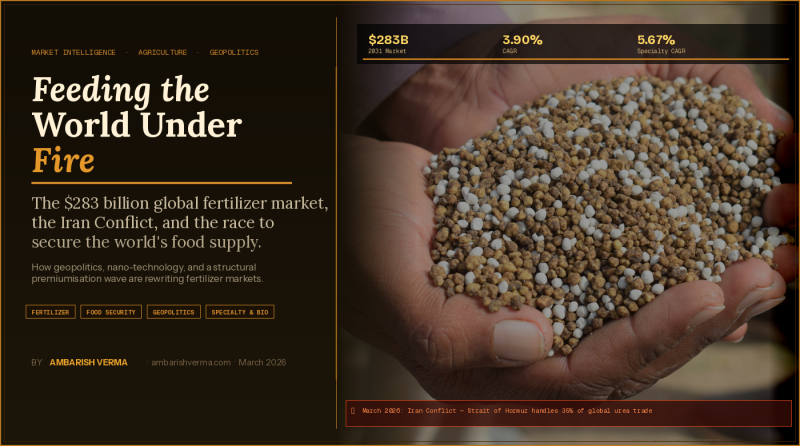
The global fertilizer market grows from USD 226 billion in 2025 to USD 283.03 billion by 2031 — a 3.90% CAGR over a six-year forecast period. To put this in context: the market adds USD 57 billion in value, equivalent to approximately one additional Nutrien-scale company in revenue terms, over just six years.

But the aggregate number is almost the least interesting part of this forecast. The real story is in the four segments — and specifically in how differently each segment is growing and why.

The Four Segments: One Market, Four Completely Different Stories

Nitrogen — The Mature Giant Under Pressure

At USD 93.3 billion in 2026 and growing at 2.54% CAGR — the slowest segment — nitrogen fertilizers are experiencing the structural headwinds of a maturing market. IFFCO’s nano-urea technology, now scaling globally through licensing agreements, is demonstrating that equivalent yields can be achieved at half the conventional application rate. Enhanced-efficiency fertilizers with urease and nitrification inhibitors are gaining regulatory mandates in the EU. And now, the March 2026 Iran Conflict has introduced an acute near-term risk: the Strait of Hormuz, through which approximately 35% of global urea trade transits, is directly in the conflict zone.

For procurement teams managing nitrogen supply chains, this is not a theoretical risk. It is an operational planning emergency that requires immediate evaluation of alternative supply routes, contractual force majeure provisions, and strategic stockpile adequacy.

Continue Reading…