
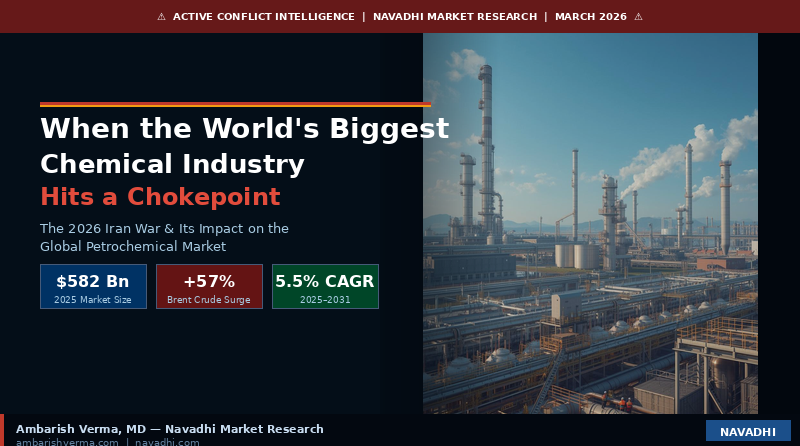
How the 2026 Iran War exposed the $582 billion global petrochemical market’s most dangerous vulnerability — and what happens next.
⚠ ACTIVE CONFLICT — Day 28 — February 28, 2026
The Strait of Hormuz is effectively closed. ~20% of global oil supply, 19% of global LNG, and an estimated $20–25 billion of annual petrochemical flows are disrupted. This article draws on Navadhi’s newly published Strategic Research Report — the most comprehensive available analysis of the Iran War’s impact on the global petrochemical market through 2031.
I want to start with something I did not expect to be writing.
When I began building Navadhi’s Global Petrochemical Market Strategic Research Report in late 2025, I was focused on a rigorous analytical question: where is this $582 billion market heading over the next six years? I was building segment-by-segment forecasts for ethylene, propylene, BTX aromatics, methanol. I was mapping CAGR trajectories for packaging, automotive, construction, agriculture. I was modelling regional growth from Asia-Pacific’s capacity expansions to Europe’s structural headwinds.
I was not writing about a war.
By the time we published that report this week — March 27, 2026 — the world had changed in ways I could not have anticipated when the first data cell was entered. On February 28, US-Israeli strikes on Iran began. The Strait of Hormuz, through which approximately 20% of global petroleum and 19% of global LNG transits, ground to a halt. The IEA described it as the “greatest global energy security challenge in history.”
And the global petrochemical industry — a $582 billion market built on feedstock supply chains that assumed this chokepoint would always be open — suddenly discovered how fragile that assumption was.
What the Strait of Hormuz Actually Controls
Most people, when they think about the Strait of Hormuz, think about oil prices. That framing — while accurate — is dangerously incomplete when you are thinking about the petrochemical industry.
The Strait is a 21-mile-wide waterway separating Iran from the Arabian Peninsula. In normal conditions, approximately 150 tankers transit it every day. Through it flows:
- ~20 million barrels per day of crude oil — roughly 20% of global petroleum
- ~110 bcm per year of LNG — 19% of global liquefied natural gas, primarily from Qatar
- ~1.2 million tonnes per day of naphtha — the primary feedstock for Asian and European steam crackers
- An estimated $20–25 billion per year of petrochemical products
When tanker traffic collapsed — to approximately 15 escorted ships per day compared to 150 in normal conditions — it was not merely an oil price event. It was a physical feedstock availability crisis for an industry that assumed its inputs would always be there.
Asian steam crackers source 60–80% of their naphtha from the Middle East. That supply has effectively stopped. What happens next is not a price question. It is a production question.
The Force Majeure Cascade Nobody Predicted
Within days of the conflict’s onset, something I had never seen at this scale began happening across the global petrochemical value chain. Force majeure declarations — legal acknowledgements that a company cannot fulfil its contractual obligations due to circumstances beyond its control — began cascading from South Korea to Taiwan to Singapore to Japan.
- Yeocheon NCC (South Korea) — the country’s largest ethylene producer at 2.28 Mt/yr capacity — declared supply force majeure. South Korea sources approximately 70% of its naphtha from the Middle East and holds only around two weeks of inventory at normal operations. This was not a precautionary filing. It was an operational emergency.
- Formosa Petrochemical (Taiwan) — one of Asia’s largest integrated petrochemical complexes — issued force majeure and reduced its No. 2 and No. 3 crackers at Mailiao to approximately 70% capacity. As a major paraxylene producer, Formosa’s curtailment sent immediate shocks through the downstream PTA-polyester chain.
- Singapore PCS — issued a formal force majeure notice to all customers, citing disruption to global maritime transportation.
- QatarEnergy — declared force majeure on all LNG exports following Iranian drone attacks on Gulf infrastructure. Qatar supplies approximately 20% of global LNG.
- Mitsubishi Gas Chemical (Japan) — confirmed the suspension of methanol supplies from Ar-Razi Saudi Methanol Company, a JV with annual capacity exceeding 4 million tonnes per year.
By mid-March, Dow CEO Jim Fitterling was speaking at CERAWeek in Houston confirming that up to 50% of global polyethylene supply was offline or constrained. Polyethylene — the plastic in your grocery bags, your food containers, your pharmaceutical packaging — was facing its most severe supply disruption in modern history.
The die is cast. Petrochemical prices will remain elevated through at least the end of 2026. The question is not whether consumers will feel this — they will. The question is how much demand destruction occurs before equilibrium is restored.”
— Jim Fitterling, Dow CEO, CERAWeek, March 26, 2026