

There’s a particular kind of dread that comes not from dramatic disasters, but from the slow revelation that something you trusted completely was never safe to begin with.
That’s the feeling I had reading the Central Pollution Control Board’s latest findings out of Bengaluru. And if you eat vegetables — which I assume you do — it should give you pause too.
What the Data Says (And What It Means for Your Dinner Table)
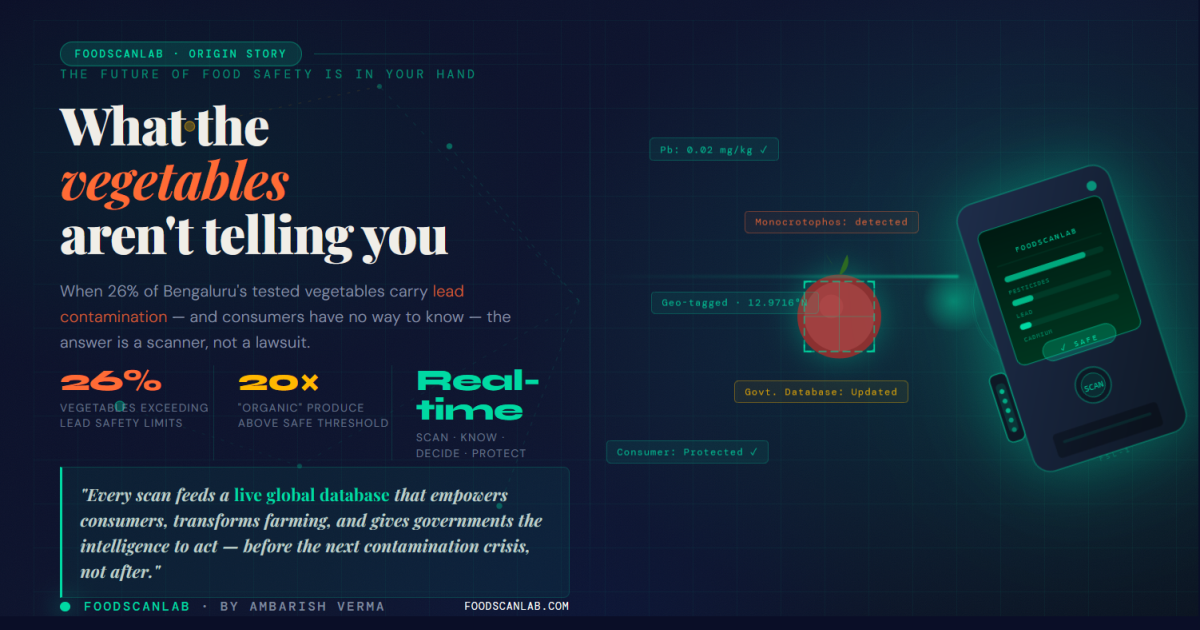
In a CPCB study whose results surfaced in prominent Indian news outlets since yesterday, researchers tested 72 vegetable samples collected from markets across Bengaluru in FSSAI-approved laboratories. The findings were stark: 26% of samples — roughly one in four — exceeded permissible limits for lead contamination.
Nineteen samples came back positive. And among them, some vegetables carrying an “organic” label showed lead levels 20 times above safety thresholds. Banned pesticides including monocrotophos were also detected in samples.
This wasn’t the first alarm. The Environment Management and Policy Research Institute (EMPRI) had already published findings in 2023 after testing 400 samples of 10 vegetables — brinjal, tomato, capsicum, beans, carrot, green chilli, onion, potato, spinach, and coriander — from 20 stores across the city, spanning everything from premium supermarkets to local markets to organic stores and Hopcoms. They found cadmium levels in coriander and spinach reaching 52.30 mg per kg against a permissible limit of 0.2 mg per kg. Nickel exceeded permissible levels at 67.9 mg per kg in some samples.
The National Green Tribunal took suo motu cognizance. The CPCB was directed to verify the situation. Committees were proposed. Reports were filed. And through all of it, the vegetables kept moving through the supply chain, landing on plates across one of India’s most educated, health-conscious, and economically prosperous cities.
Nobody at the vegetable stall knew. Nobody at the supermarket checkout knew. The consumer certainly didn’t know.
The Systemic Gap Nobody Is Talking About
Our food safety infrastructure is genuinely impressive in its institutional depth. We have FSSAI. We have CPCB. We have state-level pollution control boards. We have the NGT as a powerful judicial backstop. And we have research institutions like EMPRI doing rigorous field work.
But here’s the structural problem: every layer of this system is designed to operate at institutional scale, on institutional timelines.
A study takes months to design, months to execute, months to publish. Regulatory intervention follows legal and bureaucratic processes. Public advisories, when they come, are issued broadly and diffuse quickly. And by the time all of this happens — assuming it does — the contaminated produce has long since been consumed.
The consumer, standing at a vegetable stall with Rs. 100 in hand and a family to feed, has precisely zero tools to protect herself. She cannot run a test. She cannot see lead. She cannot smell monocrotophos. She is entirely dependent on a system that, however well-intentioned, simply cannot move at the speed of daily food purchases.
This is the gap I’ve been thinking about for years. And it’s the gap FoodScanLab™ is built to close.
What FoodScanLab™ Actually Does
FoodScanLab™ is a handheld scanner that tests produce for pesticide residues and heavy metal contamination — at the point of purchase, in real time, with no laboratory required.
You pick up the scanner. You hold it to your vegetables. You get a reading. You decide.
That’s the consumer experience. But the implications run much deeper than a single purchase decision.
For the consumer, the immediate benefit is obvious: informed choice. No more guessing whether those “organic” tomatoes are actually safer. No more hoping that the spinach you feed your child doesn’t carry cadmium at 260 times the permissible level. The power to know shifts from institutions to individuals — where it should have always been.
For farmers, the signal is market-based and immediate. When produce fails consumer scans and doesn’t sell, it delivers feedback that no government poster campaign or extension officer visit ever could. It’s not punitive — it’s honest. And it creates the economic incentive that regulation alone rarely achieves: if you want your vegetables to sell in a FoodScanLab™-aware market, you need to grow them cleanly.
This doesn’t happen overnight. But it happens. Consumer behaviour, aggregated at scale, is the most powerful force in any supply chain.
For processors and retailers, FoodScanLab™ enables real-time quality validation without sending samples to distant labs and waiting days for results. Compliance becomes faster, cheaper, and more granular.
And for governments — this is where things get genuinely exciting.
A Real-Time Food Intelligence Network
Every scan performed by a FoodScanLab™ user feeds into our proprietary, geo-tagged contamination database. Each data point carries information about what was scanned, what was found, where, and when.
At scale, this creates something that has never existed before: a living, real-time map of food contamination across geographies.
Governments that subscribe to this database gain something no EMPRI study or CPCB survey can provide — continuous, crowd-sourced, granular contamination intelligence. They can identify which farming zones are systematically producing contaminated output. They can deploy education resources to the farmers who need them most, rather than broadcasting generic advisories. They can formulate public health policy based on what’s actually happening in markets today, not what happened in a study three years ago. They can run awareness campaigns targeted with the kind of precision that transforms public health spending from a blunt instrument into a surgical one.
The Bengaluru contamination crisis, it turns out, is partly a data crisis. The problem existed long before EMPRI measured it in 2022. It took a published study, media coverage, NGT intervention, and a CPCB verification exercise — spanning more than two years — for the scale of the problem to become officially acknowledged.
FoodScanLab™ compresses that timeline from years to minutes, and makes it continuous rather than episodic.
Why I’m Building This
I want to be direct about something. I’m not building FoodScanLab™ because I think government institutions are failing. I think they’re doing their best within real constraints. I’m building it because I believe the future of food safety is not purely top-down — it’s distributed.
It’s millions of consumers making informed choices every day. It’s those choices aggregating into market signals that change farming behaviour. It’s that data flowing upward to policymakers who can act faster and smarter because they can see the ground truth in real time.
The Bengaluru numbers shook me. One in four vegetables contaminated with lead. Organic produce with lead levels twenty times the safe limit. Banned pesticides still present in the supply chain. These aren’t edge cases — they’re systematic failures that affect people who are trying to do the right thing by their families.
I kept thinking about the mother buying spinach because she read it was good for her child’s development. The retired teacher choosing organic carrots because she can afford to and wants to be careful. The young professional who switched to a vegetable-heavy diet for health reasons. None of them have any idea. And none of them should have to guess.
That’s the world I want to change. That’s why FoodScanLab™ exists.
What Comes Next
We are working to make FoodScanLab™ a reality — as a product, as a platform, and as a policy tool. The technology is coming together. The database architecture is being designed with scalability and government integration in mind from day one.
If you’re reading this and you share the conviction that food safety shouldn’t require a PhD, a laboratory, or a court order — I’d love to hear from you.
Reach out through this site, or follow the FoodScanLab™ journey at foodscanlab.com.
Because the data is already alarming. The solution is already taking shape. What we need now is the collective will to put it in the hands of every consumer who deserves better than a guess.
Sources: CPCB study on vegetable contamination in Bengaluru markets (FSSAI-approved lab results, 2025); EMPRI report on heavy metal contamination in Bengaluru vegetables (2022–2023); Deccan Herald, News18, Bar & Bench, Citizen Matters.

Leave a Reply