
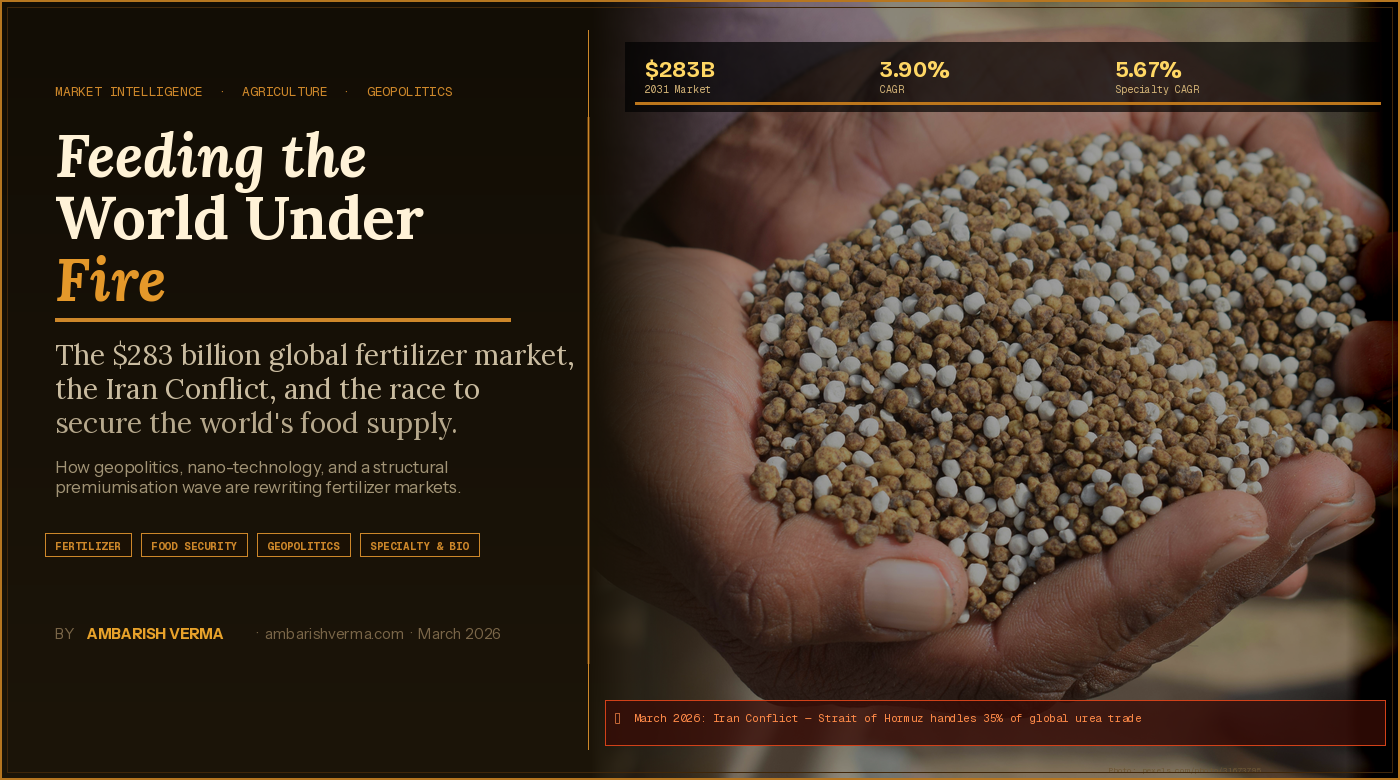

| ⚠ March 2026 Context: The Iran Conflict has emerged as a new geopolitical shock in the fertilizer market. The Strait of Hormuz — a corridor handling approximately 35% of global urea trade — is now directly exposed to conflict-driven disruption risk. This changes the near-term nitrogen market calculus in ways that no forecast published before February 2026 anticipated. |
There is a sentence I keep coming back to in the research we published today:
| The global fertilizer landscape has shifted from a period of constrained equilibrium into a state of active structural rupture. |
That is not marketing language. It is the most precise description of what the data shows when you build a rigorous bottom-up forecast of the global fertilizer market through 2031 — which is exactly what I have spent the past several months doing with the Navadhi research team.
Today we published the Global Fertilizer Market Strategic Research Report 2026–2031. This post is my personal perspective on what we found, why it matters beyond the fertilizer industry, and what I think the data is telling us about the broader food security and geopolitical landscape.
Why Fertilizers? Why Now?
Fertilizers are one of those industries that occupy a strange position in public consciousness — invisible when they work, catastrophic when they don’t. The 2022 fertilizer price crisis, triggered by Russia’s invasion of Ukraine removing two of the world’s three largest potash suppliers from Western supply chains, led to reduced application rates on hundreds of millions of hectares of farmland. Those reduced application rates translated into lower yields. Those lower yields contributed to the global food price inflation that disproportionately impacted the world’s poorest populations.
The fertilizer market is not a niche commodity sector. It is the physical substrate of global food security — and it is currently in a state of active geopolitical contestation. Understanding where it is heading is, I would argue, more strategically important than understanding where the semiconductor market or the electric vehicle market is heading, because fertilizer affects every human being on the planet through the price and availability of food.
That is why I wanted Navadhi to build this research properly, with a transparent, verified forecast model rather than recycled consensus estimates.
The Numbers: What the Forecast Actually Shows
| $226B 2025 Base Year | $283.03B 2031 Forecast | 3.90% CAGR | $57B Market Added |
The global fertilizer market grows from USD 226 billion in 2025 to USD 283.03 billion by 2031 — a 3.90% CAGR over a six-year forecast period. To put this in context: the market adds USD 57 billion in value, equivalent to approximately one additional Nutrien-scale company in revenue terms, over just six years.
But the aggregate number is almost the least interesting part of this forecast. The real story is in the four segments — and specifically in how differently each segment is growing and why.
The Four Segments: One Market, Four Completely Different Stories
Nitrogen — The Mature Giant Under Pressure
At USD 93.3 billion in 2026 and growing at 2.54% CAGR — the slowest segment — nitrogen fertilizers are experiencing the structural headwinds of a maturing market. IFFCO’s nano-urea technology, now scaling globally through licensing agreements, is demonstrating that equivalent yields can be achieved at half the conventional application rate. Enhanced-efficiency fertilizers with urease and nitrification inhibitors are gaining regulatory mandates in the EU. And now, the March 2026 Iran Conflict has introduced an acute near-term risk: the Strait of Hormuz, through which approximately 35% of global urea trade transits, is directly in the conflict zone.
For procurement teams managing nitrogen supply chains, this is not a theoretical risk. It is an operational planning emergency that requires immediate evaluation of alternative supply routes, contractual force majeure provisions, and strategic stockpile adequacy.
Phosphate — The Supply-Tightening Outperformer
At 4.74% CAGR, the phosphate segment delivers the largest absolute revenue gain in the model: USD 17.9 billion from 2026 to 2031, growing from USD 68.8 billion to USD 86.7 billion. This is a supply-side pricing story more than a demand-side volume story. China — historically the world’s largest phosphate exporter and a price-suppressing safety valve for global markets — has systematically restricted phosphate exports since 2021. DAP prices rose from USD 336 per tonne to USD 437 per tonne in 14 months.
The critical insight here is that no significant non-Chinese phosphate processing capacity will reach commercial scale before 2028–2029. The Western permitting timelines of 7–10 years mean that the supply gap created by Chinese restrictions will not be addressed within this forecast window. Phosphate buyers who have not already diversified their supply base toward OCP Morocco, Mosaic, and other non-Chinese alternatives are operating with a structurally exposed position.
Potash — The Volume Recovery Story
Potash’s 3.94% CAGR is a volume recovery narrative. The International Fertilizer Association projects potash consumption growing approximately 10% between 2024 and 2028 — the highest volume growth rate among the three macro-nutrients. This reflects the rebuilding of soil potassium reserves that were depleted during 2022–23, when price spikes caused farmers globally to dramatically reduce application rates. Brazilian soybean and corn farmers reduced potash application so significantly during this period that soil depletion is now a genuine agronomic constraint — and the rebuilding is ongoing.
Specialty & Biofertilizers — The Structural Transformation Segment
This is the segment where I believe the most significant strategic developments are occurring, and the most important structural forecast in our entire research.
| By 2030, the Specialty & Biofertilizers segment overtakes the Potash Fertilizers segment in total revenue — at USD 43.4 billion versus USD 42.8 billion respectively. This is the first time in the modern history of the global fertilizer industry that a premium, non-commodity input segment exceeds a primary macronutrient by total revenue. |
The 5.67% CAGR for this segment reflects four independently powerful growth forces operating simultaneously. The EU Farm to Fork Strategy mandates a 20% reduction in chemical fertilizer use by 2030, explicitly pushing farmers toward enhanced-efficiency and biological alternatives. India’s PM-PRANAM scheme is driving bio and organic input adoption across 140+ million smallholder farms. IFFCO’s nano-fertilizer technology licensing is spreading globally, with commercial operations developing in Brazil, Vietnam, Kenya, and Bangladesh. And carbon credit schemes for precision fertilizer application are beginning to create measurable demand pull in Europe and North America.
This structural transition — from commodity NPK toward premium, precision, and biological inputs — mirrors the transformation that occurred in the pharmaceutical sector from generics to specialty drugs, and in crop protection from broad-spectrum pesticides to targeted, precision-timed treatments. The fertilizer industry is entering this transition approximately 15 years after its adjacent sectors. The companies positioned in specialty and biological plant nutrition are entering a decade-long period of structural outperformance.
The Iran Conflict — A New Variable That Changes Near-Term Assumptions
I want to address this directly because it is the most time-sensitive element of the entire research.
The March 2026 Iran Conflict has introduced a geopolitical shock that the Navadhi report — one of the first published market forecasts to incorporate this development — characterises as having ‘surpassed previous benchmarks for geopolitical risk.’ The mechanism is the Strait of Hormuz: a narrow waterway through which approximately 35% of global urea trade transits. Any sustained disruption to tanker passage would create an immediate nitrogen supply shock, particularly acute for India (the world’s largest urea importer), Southeast Asia, and East Africa.
The longer-term structural implication is that this conflict adds another layer to the geopolitical bifurcation of fertilizer supply chains that was already underway following the Russia-Ukraine war. Western-aligned buyers face an increasingly constrained set of ‘safe’ nitrogen supply options — effectively North American (CF Industries, Nutrien), Norwegian (Yara), and Egyptian (EBIC, Abu Qir) producers. The security premium embedded in these sources will increase as the Strait of Hormuz risk remains elevated.
What This Means for Different Audiences
The report is deliberately written for a broad professional audience. Here is how I would interpret the findings for different readers:
▸ For investors and fund managers The structural crossing of Specialty & Bio over Potash by 2030 is the clearest medium-term investment signal in the data. Companies with specialty plant nutrition, biological input, and nano-fertilizer platforms (ICL Specialty, Haifa, Yara Premium, COMPO EXPERT) are entering a period of structural outperformance relative to commodity potash and conventional nitrogen peers.
▸ For corporate strategy and procurement teams The Iran Conflict nitrogen risk and the Chinese phosphate supply restriction are not theoretical. If your supply chain has more than 40% exposure to either the Strait of Hormuz route or Chinese-origin phosphate, you need a supply chain resilience review now — not when a shortage materialises.
▸ For policy and food security professionals The Africa under-fertilisation story — 17 kg/ha vs. 135 kg/ha global average — remains the single largest structural demand opportunity and food security risk in the global fertilizer market. The AFFM’s 50 kg/ha by 2030 target is achievable but requires sustained infrastructure investment and digital credit access that are still not moving fast enough.
▸ For agricultural and agribusiness professionals The premiumisation trend is real and accelerating. Farmers in Europe and North America who adopt precision nutrition, enhanced-efficiency fertilizers, and biological inputs are already seeing cost savings per tonne of yield that justify the premium. The question is not whether to transition but how fast.
A Final Reflection on Market Research in the AI Era
I am aware that in 2026, a reasonable-sounding market size estimate can be generated in minutes using AI tools. I am also aware that this creates a genuine question about the value of a formally published, USD 1,950 market research report.
Here is my honest answer: the value is not in the market size number. Any AI can produce a plausible USD 226 billion to USD 283 billion fertilizer market estimate. The value is in three things that AI cannot reliably deliver: a transparent, arithmetically verified forecast model where the segment CAGRs actually sum to the total; a geopolitically current analysis that incorporates March 2026 developments like the Iran Conflict; and a professional, citable research document that a corporate strategy team, investment manager, or policy analyst can reference with confidence in a board presentation or due diligence report.
The Navadhi Fertilizer report is exactly that — and I am proud of the rigour that went into building it.
📄 Full Report: Global Fertilizer Market Strategic Research Report 2026–2031 — Navadhi
110 pages · CAGR: 3.90% · USD 226B → USD 283B (2025–2031) · USD 1,950 Single User


Leave a Reply