
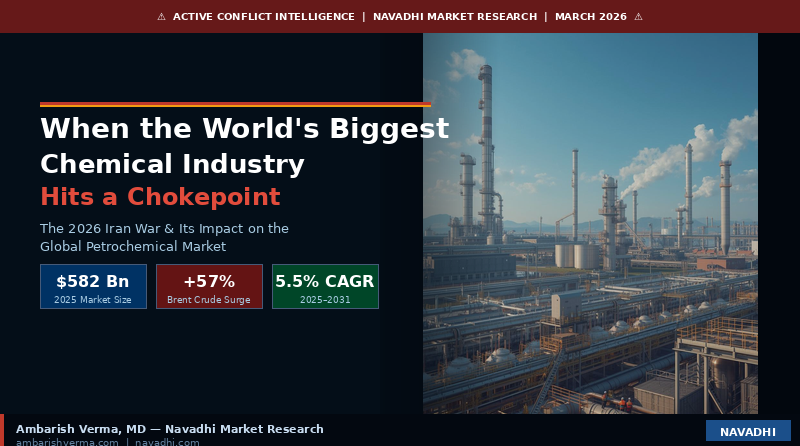

How the 2026 Iran War exposed the $582 billion global petrochemical market’s most dangerous vulnerability — and what happens next.
⚠ ACTIVE CONFLICT — Day 28 — February 28, 2026
The Strait of Hormuz is effectively closed. ~20% of global oil supply, 19% of global LNG, and an estimated $20–25 billion of annual petrochemical flows are disrupted. This article draws on Navadhi’s newly published Strategic Research Report — the most comprehensive available analysis of the Iran War’s impact on the global petrochemical market through 2031.
I want to start with something I did not expect to be writing.
When I began building Navadhi’s Global Petrochemical Market Strategic Research Report in late 2025, I was focused on a rigorous analytical question: where is this $582 billion market heading over the next six years? I was building segment-by-segment forecasts for ethylene, propylene, BTX aromatics, methanol. I was mapping CAGR trajectories for packaging, automotive, construction, agriculture. I was modelling regional growth from Asia-Pacific’s capacity expansions to Europe’s structural headwinds.
I was not writing about a war.
By the time we published that report this week — March 27, 2026 — the world had changed in ways I could not have anticipated when the first data cell was entered. On February 28, US-Israeli strikes on Iran began. The Strait of Hormuz, through which approximately 20% of global petroleum and 19% of global LNG transits, ground to a halt. The IEA described it as the “greatest global energy security challenge in history.”
And the global petrochemical industry — a $582 billion market built on feedstock supply chains that assumed this chokepoint would always be open — suddenly discovered how fragile that assumption was.
What the Strait of Hormuz Actually Controls
Most people, when they think about the Strait of Hormuz, think about oil prices. That framing — while accurate — is dangerously incomplete when you are thinking about the petrochemical industry.
The Strait is a 21-mile-wide waterway separating Iran from the Arabian Peninsula. In normal conditions, approximately 150 tankers transit it every day. Through it flows:
- ~20 million barrels per day of crude oil — roughly 20% of global petroleum
- ~110 bcm per year of LNG — 19% of global liquefied natural gas, primarily from Qatar
- ~1.2 million tonnes per day of naphtha — the primary feedstock for Asian and European steam crackers
- An estimated $20–25 billion per year of petrochemical products
When tanker traffic collapsed — to approximately 15 escorted ships per day compared to 150 in normal conditions — it was not merely an oil price event. It was a physical feedstock availability crisis for an industry that assumed its inputs would always be there.
Asian steam crackers source 60–80% of their naphtha from the Middle East. That supply has effectively stopped. What happens next is not a price question. It is a production question.
The Force Majeure Cascade Nobody Predicted
Within days of the conflict’s onset, something I had never seen at this scale began happening across the global petrochemical value chain. Force majeure declarations — legal acknowledgements that a company cannot fulfil its contractual obligations due to circumstances beyond its control — began cascading from South Korea to Taiwan to Singapore to Japan.
- Yeocheon NCC (South Korea) — the country’s largest ethylene producer at 2.28 Mt/yr capacity — declared supply force majeure. South Korea sources approximately 70% of its naphtha from the Middle East and holds only around two weeks of inventory at normal operations. This was not a precautionary filing. It was an operational emergency.
- Formosa Petrochemical (Taiwan) — one of Asia’s largest integrated petrochemical complexes — issued force majeure and reduced its No. 2 and No. 3 crackers at Mailiao to approximately 70% capacity. As a major paraxylene producer, Formosa’s curtailment sent immediate shocks through the downstream PTA-polyester chain.
- Singapore PCS — issued a formal force majeure notice to all customers, citing disruption to global maritime transportation.
- QatarEnergy — declared force majeure on all LNG exports following Iranian drone attacks on Gulf infrastructure. Qatar supplies approximately 20% of global LNG.
- Mitsubishi Gas Chemical (Japan) — confirmed the suspension of methanol supplies from Ar-Razi Saudi Methanol Company, a JV with annual capacity exceeding 4 million tonnes per year.
By mid-March, Dow CEO Jim Fitterling was speaking at CERAWeek in Houston confirming that up to 50% of global polyethylene supply was offline or constrained. Polyethylene — the plastic in your grocery bags, your food containers, your pharmaceutical packaging — was facing its most severe supply disruption in modern history.
The die is cast. Petrochemical prices will remain elevated through at least the end of 2026. The question is not whether consumers will feel this — they will. The question is how much demand destruction occurs before equilibrium is restored.”
— Jim Fitterling, Dow CEO, CERAWeek, March 26, 2026
Who Benefits. Who Is In Crisis.
One of the most important things our research makes clear is that this crisis is not uniformly negative for the global petrochemical industry. It is profoundly redistributive. Feedstock type determines everything.
LyondellBasell’s CFO confirmed at CERAWeek that North America is “the most advantaged region in feedstock” and that April order books are “the strongest in months.” Dow’s stock is up 70% year-to-date. Meanwhile, South Korea’s KOSPI fell 18% on the day war broke out and remains 13% below pre-war levels.
Product by Product: The Price Shock in Real Numbers
When you look at the feedstock math, the magnitude of the pricing disruption becomes concrete:
| Segment | Pre-War Price | Current Price (Mar 2026) | Impact Level |
|---|---|---|---|
| Ethylene (Asian) | ~$600–700/ton | ~$900–1,000/ton (+40–50%) | CRITICAL |
| Propylene | ~$700–800/ton | ~$950–1,100/ton | SEVERE |
| Methanol | ~$350–400/ton | ~$550–650/ton+ | SEVERE |
| BTX Aromatics | ~$800–1,000/ton | ~$1,100–1,400/ton | HIGH |
| Paraxylene (PX) | ~$700–850/ton | ~$1,000–1,200/ton | HIGH |
| Butadiene | ~$900–1,100/ton | ~$1,000–1,200/ton | MODERATE |
| Naphtha feedstock | ~$633/ton (Jan) | ~$875/ton | CRITICAL FEEDSTOCK |
The naphtha margin — the spread between naphtha input cost and ethylene output value — has inverted from a workable $108/ton over Brent pre-war to over $400/ton over Brent currently (LSEG data). For naphtha-fed crackers, this is existentially problematic. For US ethane crackers, this is a once-in-a-generation windfall.
The Finding That Surprised Me Most: Agriculture Is the Most Dangerous Segment
When I started this project, Agriculture / Fertilizers was the forecast’s slowest-growing application segment at 4.5% CAGR. It has become the most critically disrupted.
Here is why this matters beyond petrochemicals: approximately 50% of global urea and sulfur exports, along with 20% of global LNG used as nitrogen fertilizer feedstock, transit the Strait of Hormuz. QatarEnergy’s force majeure on all LNG exports — Qatar being the world’s dominant low-cost urea producer — has simultaneously:
- Removed major nitrogen feedstock from global supply
- Sent FOB granular urea prices from $400–490 to over $700 per metric tonne
- Created physical urea shortages in India, Bangladesh, and Sub-Saharan Africa during spring planting season
The UN World Food Programme has issued warnings analogous to the 2022 food security alerts triggered by the Russia-Ukraine fertilizer disruption. This crisis is structurally more dangerous than 2022 on every dimension that matters — more supply concentrated at a single chokepoint, disrupted during a more critical planting window.
The Structural Shifts That Will Outlast This Conflict
Every conversation I have had with industry participants in the past week has included some version of the same sentence: “Even when Hormuz reopens, things will not go back to exactly how they were.”
Our research identifies five permanent structural shifts being accelerated by this crisis:
1. North American feedstock supremacy becomes a permanent market share reality. Asian buyers are signing multi-year supply agreements with US producers during the crisis — agreements that will persist beyond conflict resolution. The physical demonstration that naphtha supply chains are a geopolitical vulnerability will drive permanent diversification.
2. Circular economy and recycled feedstocks become economically compelling, not aspirational. At $875/ton naphtha, recycled polymer feedstocks — rPET, rHDPE, pyrolysis oil from plastic waste — are dramatically more competitive than at pre-war naphtha prices. South Korean industry is actively pursuing recycled feedstock as an operational necessity, not an ESG initiative.
3. China’s coal-to-chemicals capacity receives strategic vindication. China’s coal-to-olefins (CTO/MTO) capacity — long criticised on environmental grounds but retained for strategic reasons — now gains relative competitive advantage as oil-linked petrochemical economics deteriorate for competitors globally.
4. Hormuz bypass infrastructure becomes a G7 security priority. Saudi Arabia’s East-West Pipeline and the UAE’s Habshan-Fujairah pipeline will see accelerated investment. New LNG liquefaction outside the Gulf — US, Australia, East Africa, Canada — will be fast-tracked.
5. Food security forces permanent reduction in Hormuz-dependent fertilizer procurement. Governments that discovered this vulnerability the hard way will mandate domestic ammonia capacity, strategic fertilizer stockpiles, and supply chain diversification that structurally reduces Hormuz exposure.
The Forecast: Two Paths from Here
Our research models two scenarios from this point forward:
Base Case (55–60% probability): Conflict resolves within 3–6 months. Hormuz gradually reopens mid-2026. Brent stabilises at $85–95/bbl by H2 2026. Global petrochemical market retains 5.5% CAGR through 2031, reaching ~$803 billion. 2026 is a disruption trough; 2027 begins normalisation.
Bear Case (25–30% probability): Conflict persists 12+ months. Hormuz remains disrupted through 2027. Brent sustains $100–115/bbl. CAGR compresses to 3.8–4.2%. European deindustrialisation accelerates; some Asian capacity permanently closes. 2031 market falls to ~$740–760 billion.
The most interesting finding in our scenario analysis is that base and bear cases converge by 2029–2031. Structural demand drivers — packaging growth, EV polymer demand, pharmaceutical chemicals, aerospace composites — are essentially independent of the conflict’s duration. The war delays and redistributes growth; it does not eliminate it.
What I Think About Now
I spent months building what I thought was a clean, rigorous, forward-looking market research report about the global petrochemical industry. The numbers were right. The methodology was sound. The company annual report data was carefully triangulated.
What I could not have built was a model for what happens when a 21-mile-wide chokepoint becomes a battleground.
The petrochemical industry — which makes the plastics, the fibres, the chemical intermediates that enable modern life — turned out to be more geographically concentrated, more feedstock-dependent, and more strategically vulnerable than almost anyone had publicly acknowledged. South Korea with two weeks of naphtha inventory. Taiwan running crackers at 70%. Singapore declaring force majeure. The entire Asian naphtha economy effectively suspended.
The data from this crisis will reshape how governments, producers, and buyers think about supply chain resilience for the next decade. And that, ultimately, is what makes this moment more than a commodity price event. It is a structural reassessment of where the world’s chemical building blocks come from — and how exposed we all are when that geography changes.
NAVADHI STRATEGIC RESEARCH
Read the Full Report: Impact of 2026 Iran War on Global Petrochemical Market (2026–2031)
Includes: Conflict timeline · Product price & supply impact matrix · Company SWOT (10 majors) · Regional analysis · Iran PESTLE · Policy recommendations · Three-scenario investment framework

Leave a Reply