
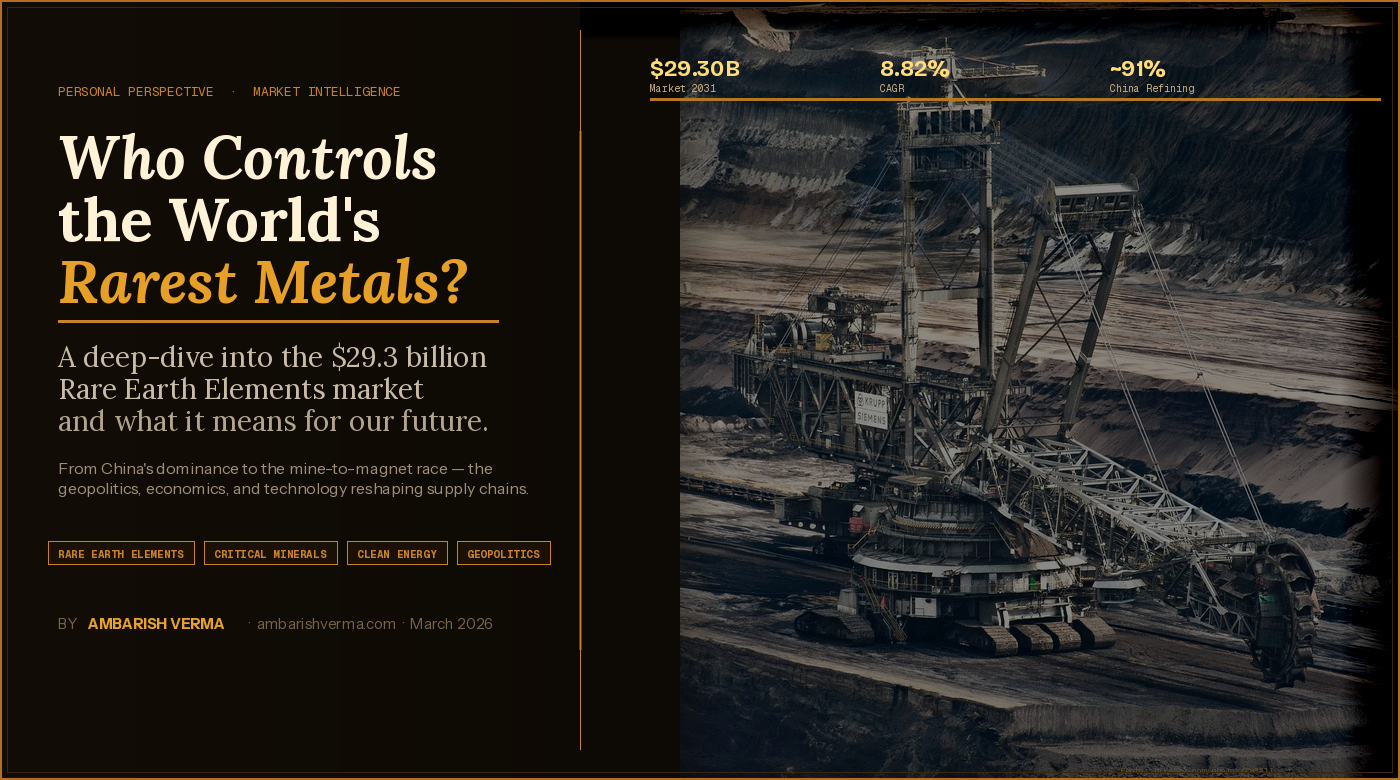

I’ll be honest with you: for most of my career, rare earth elements were a footnote. A line in a commodity table. Something the geological surveys tracked and the mining engineers worried about.
That changed for me when I started working on the research framework for what eventually became Navadhi’s Global Rare Earth Elements Market Strategic Research Report 2026–2031 . The deeper I went, the more I realised that this wasn’t a commodity story at all. It was a geopolitical story. A technology story. A story about who gets to build the future — and on whose terms.
In this post, I want to share what I’ve learned, why it matters far beyond the mining sector, and what I believe the market intelligence tells us about the decade ahead.
Let’s Start With What Rare Earths Actually Are
Despite the name, rare earth elements (REEs) are not geologically rare — cerium is more abundant in the Earth’s crust than copper. What makes them ‘rare’ is that they almost never occur in concentrated, economically mineable deposits. And what makes them strategically critical is that no other material does what they do.
A neodymium-iron-boron magnet (NdFeB) is the most powerful permanent magnet commercially available. It’s what makes your EV motor powerful enough to accelerate a 2-tonne vehicle from 0–60 in under 4 seconds while fitting in something the size of a large microwave oven. It’s what makes a 3-megawatt offshore wind turbine work without a gearbox. It’s what makes the radar in an F-35 function with the precision it does.
| There are 17 rare earth elements. The ones that really matter strategically — the ones that are genuinely difficult to source outside China — fit on one hand: neodymium, praseodymium, dysprosium, terbium, and samarium. |
The Market in Numbers: Bigger Than Most People Realise
| $17.6B Market 2025 (REO basis) | $29.30B Projected 2031 | 8.82% CAGR | 9.96% Magnets CAGR |
The numbers above come from the Navadhi report, which measures the market on a Rare Earth Oxide (REO) equivalent basis — the internationally accepted standard. This isn’t a small, specialist commodity market. At USD 17.6 billion and growing to USD 29.3 billion by 2031, it is larger than the entire global cobalt market and approaches the size of the lithium market.
The growth engine is permanent magnets. That segment is growing at 9.96% annually — faster than the overall market — because of the relentless acceleration in EV production and offshore wind deployment. When analysts talk about the energy transition, REEs are the physical enabling material that makes that transition real.
The China Problem — And Why It’s Getting Worse
Here is the central structural fact of this market: China controls approximately 60% of global rare earth mining and roughly 85–91% of global separation and refining capacity. For heavy rare earths like dysprosium and terbium, that share approaches 100%.
For decades, this was understood as an economic inconvenience — Chinese supply was cheap, abundant, and accessible, so Western buyers simply used it. The geopolitical risk was acknowledged but managed through ‘just in time’ procurement and minimal stockpiling.
That calculus changed in October 2025. China implemented what the Navadhi report identifies as ‘Announcement No. 61’ — export controls framed around national security that go beyond restricting ore or oxide exports. They target the technology of rare earth separation and magnet manufacturing itself. This is Beijing’s equivalent of a Foreign Direct Product Rule: an attempt to control global supply chains at the process level, not just the raw material level.
| Think of it this way: even if a Western company builds a rare earth processing plant, if the separation process it uses was derived from Chinese technology, China’s new rules create potential legal liability. This is a qualitatively different kind of supply risk from anything the market has faced before. |
The Three Big Findings — My Interpretation
The Navadhi report identifies what it calls the ‘Big 3’ structural findings. Let me share how I interpret each of them:
Finding 1: The supply chain is no longer an economic question — it’s a sovereignty question.
Western governments are not investing $12 billion+ in rare earth supply chains because they think it’s good business. They’re doing it because they’ve concluded that dependency on Chinese processing is a first-order national security risk. The US ‘Project Vault’, the EU Critical Raw Materials Act, and Australia’s Critical Minerals Facility are de-risking tools, not profit-seeking ones. This changes the investment calculus for the entire sector.
Finding 2: A $30% shortfall in heavy REEs is a near-certainty by 2035 if current supply trajectories hold.
Dysprosium and terbium — the heavy rare earths that give permanent magnets their thermal stability in high-performance applications — are growing in demand faster than any plausible non-Chinese supply can match. The report puts the potential shortfall at up to 30% of demand by 2035. That’s not a tail risk; it’s a central scenario under current investment trajectories.
Finding 3: The ‘mine-to-magnet’ race is the defining industrial competition of this decade.
The competitive frontier has shifted from who can mine the most REEs to who can build an integrated, sovereign supply chain — from ore in the ground to finished magnets in a motor. MP Materials, Lynas, Neo Performance Materials, and Arafura are all racing to close that gap. None is fully there yet. The winner of this race will have a decade of competitive advantage in supplying the clean energy and defence sectors.
The Top 10 Companies Shaping This Market
The companion blog post I recommend reading alongside this is the World’s Top 10 REE Companies — 2026 Edition, which profiles the competitive landscape in detail. Let me give you my synthesis.
China Northern Rare Earth (Group) is the undisputed #1 by volume, controlling the Bayan Obo deposit — the world’s largest known rare earth reserve. Its H1 2024 revenue was RMB 12.99 billion, but net profit collapsed 95.7% year-on-year as REE prices fell. By Q1 2025, the recovery had begun, with net profit surging 727% YoY as NdPr prices recovered.
Outside China, Lynas Rare Earths (Australia) remains the only significant non-Chinese rare earth producer and processor, despite reporting a 37% revenue decline in FY2024 due to price compression. MP Materials controls Mountain Pass — the only operating REE mine in the US — and is building domestic magnet manufacturing capability with DoD backing. Neo Performance Materials, with processing in Estonia, offers the only meaningful Western heavy REE separation capacity.
Arafura Rare Earths, still pre-revenue, is advancing the Nolan’s Bore NdPr deposit in Australia — and if it reaches commercial production, it could be one of the most strategically significant non-Chinese REE projects of this decade.
What Does This Mean for You?
I write about market research because I believe that understanding structural market forces is what separates reactive decision-making from proactive strategy. Here’s what I think the REE market is telling us, depending on who you are:
If you’re an investor: The REE market is entering a multi-year investment supercycle driven by both demand pull (clean energy, defence) and supply push (government-backed build-out). The risk-adjusted opportunity is in midstream processing and integrated mine-to-magnet players, not junior miners alone. The Navadhi report provides the company-level intelligence to identify where in the value chain the risk-reward is best.
If you’re in procurement or operations: Now is the time to build supply chain resilience into your planning — not when a crisis hits. Map your REE exposure by element and application. Understand which of your suppliers sits on Chinese feedstock. Engage Western refiners early, before their offtake books are full.
If you’re in policy or government: The permitting timeline for a new Western mine is 7–10 years. That means decisions made today about regulatory reform will determine supply security in 2033–2035. The 30% heavy REE shortfall forecast is not inevitable — but avoiding it requires policy action starting now.
Final Thought
| The rare earth elements market is one of those places where the intersection of geopolitics, technology, and capital markets creates genuinely rare windows of insight. We are in one of those windows right now. |
The Navadhi report is the most comprehensive piece of research I’ve been involved with on this topic — covering market sizing, segment forecasts, SWOT and PESTLE analysis, competitive intelligence on 9 major companies, and strategic scenario analysis through 2031. I’d encourage anyone with exposure to this market — directly or indirectly — to read it.
As always, I’m happy to discuss the findings with anyone who’d like to dig deeper. Drop me a message or leave a comment below.
📄 Full Report: Global REE Market Strategic Research Report 2026–2031 by Navadhi Market Research
📖 Companion Blog: World’s Top 10 REE Companies — 2026 Edition


Leave a Reply